1

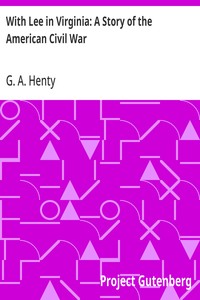
With Lee in Virginia: A Story of the American Civil War — A Closer Reading
(0 User reviews)
565
Project Gutenberg
2001
Not confirmed
United States -- History -- Civil War, 1861-1865 -- Fiction; Lee, Robert E. (Robert Edward), 1807-1870 -- Fiction; Virginia -- History -- Civil War, 1861-1865 -- Fiction
Readers of public-domain and historical texts
Project Gutenberg digital edition
en
Edition facts
Words
128,038
Reading time
557 min
Text sections
10
Before opening With Lee in Virginia: A Story of the American Civil War — A Closer Reading, the edition data offers a quick orientation: 128,038 words, 9 hr 17 min estimated reading time, and 10 detected text sections.
The text analysis averages about 20.8 words per sentence, while the detected sections provide another way to judge how the source is divided.
Project Gutenberg metadata also associates the work with “United States -- History -- Civil War, 1861-1865 -- Fiction,” connecting these edition facts with the source record’s subject description.
Source:
Project Gutenberg record #2805
This editorial note examines G. A. Henty's diction, dialogue, and descriptive choices in 'With Lee in Virginia,' focusing on how the author constructs a Confederate-aligned perspective through the protagonist Vincent Wingfield's observations and interactions.
Read the complete public-domain text at its original source.
Read on Project GutenbergG. A. Henty's With Lee in Virginia opens with a preface that frames the American Civil War as a contest between a weaker, heroic South and a numerically superior North, a lens that shapes the entire narrative. The author's diction consistently aligns the reader with the Confederate cause, as seen when the protagonist Vincent Wingfield reflects on the destruction of private property by Union forces under Pope, calling it "new and very painful." Henty's choice to filter events through Vincent's perspective ensures that the reader experiences the war from a Southern point of view, with moral judgments embedded in the narrative voice.
Diction and Moral Framing
Henty's word choices carry implicit moral weight. When Vincent observes "ruined farms and burned houses," the description is not neutral; it is paired with his indignation that in Virginia private property had been respected until Pope's command. The phrase "this phase of civil war was new and very painful to him" uses painful to convey personal and moral distress, not just tactical inconvenience. Similarly, Vincent's wish that generals on both sides would "join each other in hunting down and hanging these marauding scoundrels" employs scoundrels to condemn irregular fighters, while he exempts Mosby's band as "composed almost entirely of gentlemen." This lexical distinction—scoundrels versus gentlemen—reveals Henty's effort to differentiate between honorable and dishonorable combatants, a key theme in his portrayal of the war.
Dialogue as Characterization
Dialogue in the excerpts serves to establish character and social hierarchy. The old negress Chloe speaks in dialect: "De house am pretty well cleared out ob eberyting" and "here am tief want to break into the house." Her speech is marked by nonstandard grammar and pronunciation, contrasting sharply with Vincent's formal, educated English. When she calls for "Massa Charles" to bring his "shot-gun," the use of Massa reinforces the plantation social order. In contrast, the young girl Lucy speaks standard English: "Open the door, Chloe; that is not the voice of a robber." Her calm, authoritative tone overrides Chloe's fear, demonstrating her class position. Henty uses these linguistic markers to delineate race, class, and authority without explicit commentary.
Descriptive Economy and Setting
Henty's descriptions are functional, often serving plot needs rather than atmosphere. When Vincent searches for a boat to cross the river, the narrative notes "no craft of any kind was visible, although in many places there were stages by the riverside." The detail of the stages—used by farmers for unloading produce—grounds the scene in a specific economic activity, but the absence of boats is explained pragmatically: they were "collected and either sunk or carried away." This economical description avoids embellishment, focusing on obstacles to Vincent's mission. Similarly, the house Vincent approaches is described minimally: "small, but seemed to have belonged to people above the class of farmer," with a "little plantation" and "veranda." The detail that "most of the blinds were down" hints at war-time caution, but Henty does not linger on visual imagery; he moves quickly to dialogue and action.
Narrative Voice and Point of View
The narrative is closely tied to Vincent's consciousness, using free indirect discourse to convey his thoughts. When he decides to approach a farmhouse, the text states: "Vincent concluded at last that at some period of the struggle all the boats must have been collected..." The phrase at some period reflects his uncertainty, and the reasoning is his own. Later, when he knocks on the door, the reader shares his perspective: "He took off his hat" and speaks politely. The shift to the negress's alarmed viewpoint is brief, but the narrative quickly returns to Vincent. This consistent focalization aligns the reader with the protagonist's judgments, such as his view of "marauding scoundrels" and his trust in Lucy's voice over Chloe's fear. Henty's choice to limit the narrative to Vincent's point of view reinforces the partisan lens established in the preface.
Structural Patterns in the Excerpts
The excerpts reveal a recurring structural pattern: Vincent encounters a problem, assesses the situation, and takes action. For example, after failing to find a boat, he "determined now to approach one of them and endeavor to gain some information." The pattern repeats when he decides to try a small house after spending another night in the wood. Each decision is preceded by a brief deliberation, often weighing risks: "He passed two or three large farmhouses without entering, for although the greater part of the male population were away... he might still find two or three hands." This methodical pacing gives the narrative a procedural feel, emphasizing Vincent's resourcefulness. The pattern also serves to build suspense, as each encounter carries the threat of discovery or danger, a technique Henty uses to maintain reader engagement across the novel's length.
Readers attentive to Henty's authorial choices will notice how diction, dialogue, and description work together to construct a specific moral and political perspective. The narrative's close alignment with Vincent's point of view, the use of dialect to mark social roles, and the economical descriptions that prioritize plot over atmosphere are all deliberate techniques. These elements, traceable in the excerpts, invite scrutiny of how historical fiction shapes its readers' sympathies through craft rather than argument.
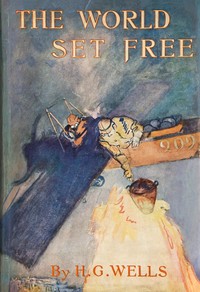
Reading Henty’s novel again, I found myself lingering on young Vincent’s quiet certainty—how easily loyalty shapes what a person allows themselves to see. That same wistful conviction surfaced later in The World Set Free — Background and Themes, where hope and catastrophe blur so gently. Both books, in their own ways, make me wonder how we hold onto faith during long, confusing dusk.
There are no reviews for this eBook.
There are no comments for this eBook.
Reader reflection
What was your reading experience?
Capture what you thought, learned, and would like to remember.
Your progress
0
/
10
2
Was reading this book enjoyable?
3
Would you recommend this book to another reader?
4
How easy was the book to follow?
5
Could you follow the author’s main argument?
6
Would you like to discuss this book with someone?
7
Did anything about the book feel genuinely new?
8
Would you read this book again?
9
In one sentence, what did you learn?
10