1

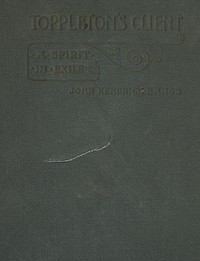
Toppleton's Client; Or, A Spirit in Exile — Reading Notes
(0 User reviews)
1511
Project Gutenberg
2010
Not confirmed
Humorous stories; Ghosts -- Fiction; Legal stories
Readers of public-domain and historical texts
Project Gutenberg digital edition
en
Edition facts
Words
61,271
Reading time
267 min
Text sections
7
Before opening Toppleton's Client; Or, A Spirit in Exile — Reading Notes, the edition data offers a quick orientation: 61,271 words, 4 hr 27 min estimated reading time, and 7 detected text sections.
The text analysis averages about 20.9 words per sentence, while the detected sections provide another way to judge how the source is divided.
Project Gutenberg metadata also associates the work with “Humorous stories,” connecting these edition facts with the source record’s subject description.
Source:
Project Gutenberg record #34171
An editorial note examining John Kendrick Bangs' comic diction, the legal-fantasy premise of a spirit in exile, and the narrator's ironic voice in Toppleton's Client.
Read the complete public-domain text at its original source.
Read on Project GutenbergJohn Kendrick Bangs opens Toppleton's Client; Or, A Spirit in Exile with a portrait of Hopkins Toppleton as a barrister whose chief asset is not legal acumen but a surname inherited from his father. The narrator describes Toppleton's income as "as far removed from instability" as the pyramids, a simile that sets the tone for the book's blend of legal satire and supernatural comedy. The firm's name—a string of eight surnames—is itself a joke about the inflation of Victorian partnerships.
The Value of a Name
The opening chapter dwells on the commercial worth of Toppleton's patronymic. Plaintiffs withdraw suits and defendants flee when they see the name, even though Hopkins himself knows "scant" law. Bangs treats the name as a commodity: the firm retains it for a share of profits, and the narrator notes that the father's "pre-eminent success at the Bar" made the name a weapon. This satirizes how reputation can outweigh competence, a theme that recurs when the spirit later trades on borrowed identity.
Invisible Society and Embodied Frustration
The weary spirit recounts being kept from polite society because his invisible state embarrasses his host. The fiend suggests he "float" invisibly over trees or sit on the throne of England—a sardonic catalogue of freedoms that are actually exclusions. The spirit's retort, "I don't care to travel about in that impersonal fashion," reveals his desire for embodied social life. Bangs uses the ghost's predicament to mock the rituals of Victorian visibility: bowing, being seen, and the social labor of explaining snubs.
Cross-Examination as Courtship
When the spirit proposes to Miss Hicksworthy-Johnstone, he faces a "cross-examination" lasting two and a half hours. Bangs borrows legal vocabulary for romance: the spirit must give "plausible answer" to "embarrassing" questions, and Toppleton quips that the fiend left "a little of his brain" behind. The scene treats love as a trial, with the beloved as examiner. The spirit's relief at being called by his first name echoes a verdict of acquittal, blending the book's legal framework with its supernatural comedy.
Diction and the Comic Supernatural
Bangs' diction mixes formal legalese with colloquial asides. The spirit describes the fiend as "visible like a bit of sea-fog," a simile that is precise and faintly absurd. The narrator uses understatement: the spirit's proposal succeeds "in some way, I know not how." These choices keep the supernatural premise grounded in a recognizably human voice. The book's humor depends not on gothic dread but on the mundane frustrations of an invisible man navigating dinner parties and hansoms.
Readers attentive to Bangs' wordplay will find a satire that uses the ghost story to examine social performance, professional reputation, and the rituals of Victorian life. The excerpts suggest a novel more interested in the comedy of manners than in horror, with a narrator whose ironic distance invites the reader to smile at both the spirit's plight and Toppleton's complacency.
Reading about Toppleton’s exiled spirit, I remembered sitting on my grandmother’s porch, the same hush settling over me when I first met Mowgli’s loneliness among the wolves. Both books whisper that belonging is a borrowed room, not a birthright. That ache lingers like dusk. The Second Jungle Book — Inside the Classic held that same quiet, homesick pulse.
There are no reviews for this eBook.
There are no comments for this eBook.
Reader reflection
What was your reading experience?
Capture what you thought, learned, and would like to remember.
Your progress
0
/
10
2
Was reading this book enjoyable?
3
How likely are you to recommend this book?
4
How easy was the book to follow?
5
How much did the book move you?
6
Did the book deliver what you hoped for?
7
How strong was your personal connection to the text?
8
Was the book easy to understand?
9
In one sentence, what did you learn?
10