1

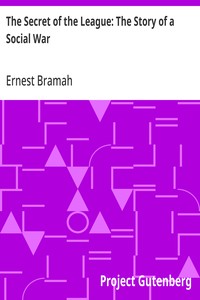
The Secret of the League: The Story of a Social War — Reading Companion
(0 User reviews)
215
Project Gutenberg
2010
Not confirmed
Social classes -- Fiction; Dystopias -- Fiction; Great Britain -- Politics and government -- Fiction
Readers of public-domain and historical texts
Project Gutenberg digital edition
en
Edition facts
Words
98,429
Reading time
428 min
Text sections
9
Before opening The Secret of the League: The Story of a Social War — Reading Companion, the edition data offers a quick orientation: 98,429 words, 7 hr 8 min estimated reading time, and 9 detected text sections.
The text analysis averages about 19.6 words per sentence, while the detected sections provide another way to judge how the source is divided.
Project Gutenberg metadata also associates the work with “Social classes -- Fiction,” connecting these edition facts with the source record’s subject description.
Source:
Project Gutenberg record #34522
Ernest Bramah's 1909 dystopian novel uses a shifting narrative voice—from drawing-room repartee to telescribe urgency—to trace a social war in a future Britain. The opening debate over flying sets a tone of generational conflict that recurs in the secretive Order of St. Martin and the League's political maneuvering.
Read the complete public-domain text at its original source.
Read on Project GutenbergThe novel opens not with a manifesto but with a polite argument on the Hastings promenade. Miss Lisle, a young woman, defends flying against older matrons who find it unnatural. Her retort—that bicycles once shocked grandmothers—establishes a pattern of generational friction that runs through the book. The dialogue is crisp, the social setting precise. This is not a dystopia announced by catastrophe but by a shift in what people consider normal.
Bramah’s narrative voice soon abandons the drawing room for the telescribe and the secret committee room. The prose tightens. When Sir John Hampden, having delivered a deathbed message as an agent of the Order of St. Martin, resolves to counter his own actions as President of the Unity League, the language becomes clipped and urgent. The change in pace mirrors the novel’s move from social comedy to political thriller.
From Promenade to Telescribe: Shifts in Voice and Pace
The early chapters rely on dialogue and social observation. The argument about flying is leisurely, full of “murmur of polite dissent” and “unfeeling candour”. Bramah lets the scene breathe. By Chapter XII, the pace has changed entirely. Hampden stands before a telephone, and the prose becomes a series of short, functional sentences: “He had already made it.” The telescribe—a fictional wireless device—becomes a symbol of compressed time. The novel’s voice shifts from ironic to almost breathless, tracking the pressure on its protagonist.
This change is not arbitrary. The opening’s social comedy establishes the world; the later chapters show that world under strain. The reader who notices the acceleration in prose will find it mirrors the plot’s mounting stakes.
The Weight of a Single Envelope
Bramah builds tension around a small object: an unsealed envelope. Hampden carries it for half an hour, “with the unsealed envelope in his pocket, and no eye had been upon him.” The narrative voice dwells on his internal calculation—“he would have given a considerable sum of money … to know the extent of those notes”—before he acts. The language here is precise, almost legalistic, reflecting Hampden’s divided loyalties.
The envelope is never described in detail. Its power comes from what it represents: a secret that cannot be taken back. Bramah uses this concrete detail to anchor the novel’s abstract conflict between class and class. The reader is left to infer the contents from the characters’ reactions, a technique that keeps the focus on moral pressure rather than technical exposition.
The Order of St. Martin and the Language of Duty
When Hampden identifies himself to Mr. Tubes, he uses a formal, almost ritualistic phrase: “What I have done, I have done as a servant of the Order of St Martin.” The sentence structure is balanced, archaic. It contrasts sharply with the clipped urgency of the telescribe scene. Bramah gives the Order a distinct linguistic register—solemn, hierarchical—that sets it apart from the League’s more pragmatic tone.
This stylistic choice reinforces the novel’s theme of competing allegiances. Hampden speaks differently depending on which role he inhabits. The reader can track his internal conflict through these shifts in voice. The Order’s language implies a code of honor; the League’s language implies strategy. Bramah does not resolve the tension, leaving the reader to weigh the two against each other.
Readers will find that the novel rewards attention to its smallest details: the way a character’s speech changes when they enter a different room, the precise timing of a telephone call, the weight of an envelope. Bramah’s prose is never careless. The shifts in pace and voice are not flaws but signals. To follow them is to understand the social war not as a backdrop but as a force that reshapes how people speak and decide.
The rain made the drawing-room debates in Bramah’s future Britain feel almost cozy, that strange unease of power shifting behind velvet curtains. Later, I found myself thinking of that same velvet opacity in The History of Caliph Vathek — Background and Themes, where a caliph’s pride builds its own silent prison. Different century, same quiet weight of consequence pressing down.
There are no reviews for this eBook.
There are no comments for this eBook.
Reader reflection
Before you leave, reflect on the book
Use these questions to collect your thoughts before moving on.
Your progress
0
/
10
2
Did this book hold your interest?
3
How likely are you to recommend this book?
4
How easy was the book to follow?
5
Is this a title worth rereading?
6
Did the book give you something worth debating?
7
How did the pace of the book feel?
8
Did any part of the book stay with you emotionally?
9
What did this book teach you most?
10