1

Doom of the House of Duryea — A Reader’s Guide
(0 User reviews)
1760
Project Gutenberg
2010
Not confirmed
Short stories; Horror tales; Vampires -- Fiction
Readers of public-domain and historical texts
Project Gutenberg digital edition
en
Edition facts
Words
8,802
Reading time
39 min
Text sections
1
Doom of the House of Duryea — A Reader’s Guide can be approached with a clearer sense of reading commitment from its source measurements: 8,802 words, 39 min estimated reading time, and 1 detected text section.
The text analysis averages about 17.2 words per sentence, while the detected sections provide another way to judge how the source is divided.
Project Gutenberg metadata also associates the work with “Short stories,” connecting these edition facts with the source record’s subject description.
Source:
Project Gutenberg record #32710
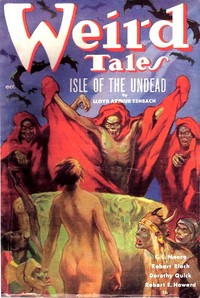
Earl Peirce's 1936 Weird Tales story uses a measured, almost clinical narrative voice to escalate dread, with a father-son reunion shadowed by a family curse involving the vrykolakas. The prose shifts from restrained dialogue to frantic interior panic, keyed to physical symptoms like headaches and throat pains.
Read the complete public-domain text at its original source.
Read on Project GutenbergThe story opens with Arthur Duryea striding into a hotel lobby, his steps described as having 'the spring of elastic in them'—a small, precise detail that signals both vitality and tension. The narrative voice is restrained, almost clinical, as it tracks the father-son reunion through clipped dialogue and loaded gestures: a hand shaking so hard the son must cup the match, a sigh that 'fell from his lips like a prayer.' Peirce builds unease not through gothic excess but through what is withheld—the father's livid pallor, the son's clogged voice, the unspoken weight of twenty years.
A Voice That Holds Back
The prose in the opening pages is notably economical. Sentences are short, actions are described without emotional commentary: 'Arthur took the pen and scribbled his name rapidly. Without a further word, neglecting even to get his key and own room number, he turned and walked to the elevators.' The narrator reports behavior but does not interpret it, leaving the reader to sense the strain beneath the surface. This restraint extends to dialogue, where characters speak in fragments and non sequiturs. When Arthur confesses his surprise at his father's appearance, Duryea snaps back: 'What did you expect, Arthur? An evil eye? A shaven head and knotted jowls?' The retort is sharp, but the narrative does not dwell on it. The effect is a voice that seems to be deliberately averting its gaze, as if afraid of what it might see if it looked too closely.
The Turn: From Restraint to Physical Panic
Once the scene shifts to Timber Lake Lodge, the narrative pace quickens and the physical symptoms take over. Arthur's headache and throat pain are introduced as sudden, intrusive details: 'I—I don't think I'll shave, Dad. My head aches.' The father's response is immediate and suspicious: 'What do you mean—your head aches? How? Does your throat——' The dialogue becomes staccato, punctuated by dashes and abrupt interruptions. Peirce uses bodily sensation as a narrative engine—the pain is not merely described but enacted through the characters' reactions. Arthur 'jerked himself away,' his face 'suddenly white.' The prose itself becomes more fragmented, mirroring the characters' loss of control. The measured voice of the opening gives way to a rhythm of gasps, pauses, and physical jolts.
The Embedded Text: A Shift in Authority
Midway through the excerpt, the narrative voice yields to a long, quoted passage from a book Arthur finds—a scholarly description of the vrykolakas. This embedded text is written in a dry, academic register: 'As in the case of Autiel Duryea we observe that this specimen of vrykolakas preys only upon the blood in its own family.' The contrast with the surrounding fiction is stark. Where the main narrative withholds and implies, this passage explains and categorizes. It introduces a pseudo-scientific framework for the curse, complete with terms like 'medium,' 'coalescence,' and 'inherent demonism.' The shift in voice is a structural gamble: it pauses the action to deliver exposition, but the clinical tone makes the horror feel more inevitable, as if the characters are merely fulfilling a biological law. The effect is to transform dread from a mood into a diagnosis.
Pay attention to how Peirce uses physical space—the hotel lobby, the lodge, the stairs—as a stage for proximity and separation. The characters are constantly moving toward or away from each other, and the narrative tracks these movements with precision. The story's horror depends less on what is seen than on what is sensed through the body: a headache, a throat pain, a hand that shakes. Reading with an eye to these somatic cues reveals the craft beneath the pulpy surface.
That quiet horror in Duryea—how the body betrays before the mind accepts—stayed with me for weeks. It reminded me of something gentler, oddly: The History of Don Quixote, Volume 1, Part 04 — Text and Context where the ache of disappointment slowly replaces a noble dream. Both feel like the slow unraveling of a voice you trusted. I thought of that on a long walk yesterday, and just wanted to tell you.
There are no reviews for this eBook.
There are no comments for this eBook.
Reader reflection
Record your reading impressions
A brief reflection can help important ideas stay with you longer.
Your progress
0
/
10
2
How did the book work for you overall?
3
Is this a title you would suggest to others?
4
How much effort did this book require?
5
How would you describe its reading pace?
6
Did it raise ideas you would like to talk about?
7
Would a second reading be valuable?
8
How clearly were the main ideas presented?
9
Which lesson or insight stayed with you?
10