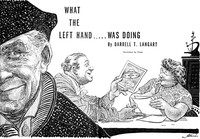
What The Left Hand Was Doing — A Closer Reading
Edition facts
For What The Left Hand Was Doing — A Closer Reading, the stored edition analysis reports 13,845 words, 1 hr 1 min estimated reading time, and 2 detected text sections.
The text analysis averages about 16.5 words per sentence, while the detected sections provide another way to judge how the source is divided.
Project Gutenberg metadata also associates the work with “Science fiction,” connecting these edition facts with the source record’s subject description.
Calculated from edition completeness, EPUB availability, text structure and catalogue metadata. Not a user rating.
How this score is calculated
- Description quality20 pts
- Title & short description10 pts
- Source metadata20 pts
- Text length15 pts
- Chapters / structure15 pts
- EPUB file integrity20 pts
Total of 100 points, scaled to a 2.5-5.0 range. Editions with an empty description or a missing EPUB file are not scored.
Read the Text
Someone had to handle the crackpots and lunatic-fringe fanatics that came to the Society, and one of their own kind could do the job better than anyone else. As long as Mrs. Jesser and Mr. Balfour were on duty, the Society's camouflage would remain intact.
Spencer Candron gave Mrs. Jesser a friendly gesture with one hand and then headed up the stairs. He would rather not have bothered to take the stairway all the way up to the fifth floor, but Mrs. Jesser had sharp ears, and she might wonder why his foot-steps were not heard all the way up. Nothing--but _nothing_--must ever be done to make Mrs. Jesser wonder about anything that went on here.
The door to Brian Taggert's office was open when Candron finally reached the fifth floor. Taggert, of course, was not only expecting him, but had long been aware of his approach.
Candron went in, closed the door, and said, "Hi, Brian," to the dark-haired, dark-eyed, hawk-nosed man who was sprawled on the couch that stood against one corner of the room. There was a desk at the other rear corner, but Brian Taggert wasn't a desk man. He looked like a heavy-weight boxer, but he preferred relaxation to exercise.
But he did take his feet from the couch and lift himself to a sitting position as Candron entered. And, at the same time, the one resemblance between Taggert and Candron manifested itself--a warm, truly human smile.
"Spence," he said warmly, "you look as though you were bored. Want a job?"
"No," said Candron, "but I'll take it. Who do I kill?"
"Nobody, unless you absolutely have to," said Taggert.
Spencer Candron understood. The one thing that characterized the real members of The Society for Mystical and Metaphysical Research--not the "front" members, like Balfour and Mrs. Jesser, not the hundreds of "honorable" members who constituted the crackpot portion of the membership, but the real core of the group--the thing that characterized them could be summed up in one word: _understanding_. Without that one essential property, no human mind can be completely free. Unless a human mind is capable of understanding the only forces that can be pitted against it--the forces of other human minds--that mind cannot avail itself of the power that lies within it.
Of course, it is elementary that such understanding must also apply to oneself. Understanding of self must come before understanding of others. _Total_ understanding is not necessary--indeed, utter totality is very likely impossible to any human mind. But the greater the understanding, the freer the mind, and, at a point which might be called the "critical point," certain abilities inherent in the individual human mind become controllable. A change, not only in quantity, but in quality, occurs.
A cube of ice in a glass of water at zero degrees Celsius exhibits certain properties and performs certain actions at its surface. Some of the molecules drift away, to become one with the liquid. Other molecules from the liquid become attached to the crystalline ice. But, the ice cube remains essentially an entity. Over a period of time, it may change slowly, since dissolution takes place faster than crystallization at the corners of the cube. Eventually, the cube will become a sphere, or something very closely approximating it. But the change is slow, and, once it reaches that state, the situation becomes static.
But, if you add heat, more and more and more, the ice cube will change, not only its shape, but its state. What it was previously capable of doing only slightly and impermanently, it can now do completely. The critical point has been passed.
Roughly--for the analog itself is rough--the same things occurs in the human mind. The psionic abilities of the human mind are, to a greater or lesser degree, there to begin with, just as an ice cube has the _ability_ to melt if the proper conditions are met with.
The analogy hardly extends beyond that. Unlike an ice cube, the human mind is capable of changing the forces outside it--as if the ice could seek out its own heat in order to melt. And, too, human minds vary in their inherent ability to absorb understanding. Some do so easily, others do so only in spotty areas, still others cannot reach the critical point before they break. And still others can never really understand at all.
The novella opens with a detailed description of an unremarkable brick building in Arlington, Virginia, that houses the Society for Mystical and Metaphysical Research. The narrator emphasizes that this name is both a perfect cover—dismissed as crackpot—and literally true. The protagonist, Spencer Candron, is introduced as physically unprepossessing, with a face that includes a “well-formed snub nose” and a “firm cleft chin.” His matter-of-fact attitude toward the building mirrors the organization’s own unassuming exterior. This opening establishes a key tension: the story will operate on two levels, the mundane and the hidden.
The Cover as Truth
The Society for Mystical and Metaphysical Research is described as “no more nearly perfect cover” because it is both obviously crackpot and perfectly accurate. This paradox sets up the story’s central conceit: that the most convincing deception is something the other fellow already knows for sure is the truth. The building’s history—from private home to apartment building to headquarters—mirrors the layering of appearances. Candron’s own appearance, with his “introspective gray eyes” and conservative clothing, similarly conceals his true function. Readers are invited to watch for other instances where the obvious masks the real.
Psychic Ability as a Tool
Candron’s psychic abilities are revealed gradually through action rather than exposition. In the middle excerpt, he uses his mind to sense the nearness of others, to “bring his loathing for the bottom into the fore” to float up an elevator shaft, and to detect sleeping minds as “dimmed, chaotic thoughts.” These details show that his power is not telepathy but a form of extrasensory perception tied to emotion and spatial awareness. The story treats this ability as a practical skill, not a mystical gift, and it is deployed with precision in the prison break sequence.
Impersonation and Infiltration
The later excerpt details Candron’s methodical impersonation of a Chinese general and a psychologist to free a prisoner named James Ch’ien. He has studied recordings of a man’s voice for hours to get “the exact inflection, accent, and usage.” He uses two secret phone numbers to issue orders, then physically infiltrates the building by dropping down elevator shafts. The guards are suspicious but ultimately convinced by his calm demeanor and reference to Confucius. This sequence demonstrates how the story blends Cold War espionage tropes with psychic abilities, treating the latter as another tool in a spy’s kit.
Setting and Atmosphere
The story’s settings are rendered with precise, functional detail. The Arlington building is within “howitzer range of the capitol” and close to the Pentagon, grounding the fantastic elements in a recognizable geography. The prison in China is described through its layout: living quarters for officers, elevator shafts, a subbasement with a twenty-four-hour guard watching via hidden television pickups. These details create a sense of verisimilitude that contrasts with the psychic abilities. The matter-of-fact tone—Candron “floated up to the top floor” as if it were routine—reinforces the story’s blend of the ordinary and the extraordinary.
Readers approaching this novella for the first time will benefit from paying attention to how the narrator presents extraordinary events as commonplace. The story’s effectiveness lies in its refusal to dwell on the wonder of psychic powers, instead focusing on the practical problems of infiltration and deception. The excerpts suggest a tight, plot-driven narrative that rewards attention to small details of setting and character behavior.
I keep returning to that moment in Garrett's novella where the prison break hinges on what the protagonist’s left hand did—unbidden, almost forgotten. It reminded me, quietly, of reading The Crack of Doom — Background and Themes, where the same sense of lurking inevitability colors every choice. Both feel less like action and more like watching a stubborn clock finally strike.
Isaac Martinez
2 weeks ago-
Ryan Maldonado - 1 month ago
'What the Left Hand Was Doing' is a cleverly constructed tale that plays with expectations. The narrative weaves multiple threads into a coherent whole, leaving you surprised and satisfied. The character development is strong, and the writing is crisp. A hidden gem that deserves more attention. Highly recommended for those who enjoy intricate storytelling. -
Elizabeth Buck - 1 month ago
An interesting read with a unique premise. The plot twists keep you engaged, though at times they feel contrived. The prose is workmanlike but functional. For readers who appreciate literary puzzles, it's worth a look. Not a masterpiece, but a decent way to spend an afternoon. -
Cody Johnson - 3 weeks ago
I found this book confusing and ultimately unsatisfying. The narrative jumps around without clear purpose, and the resolution feels abrupt. The characters are underdeveloped, and the central metaphor is strained. It seems to aim for profundity but misses the mark. I'd skip it unless you're a completist.
Before you leave, reflect on the book
Use these questions to collect your thoughts before moving on.
Henry Robinson
2 weeks ago