1

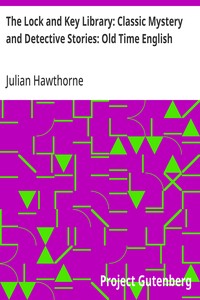
The Lock and Key Library: Classic Mystery and Detective Stories: Old Time English — Inside the Classic
(0 User reviews)
273
Project Gutenberg
1999
Not confirmed
Fiction; Detective and mystery stories; Ghost stories
Readers of public-domain and historical texts
Project Gutenberg digital edition
en
Edition facts
Words
135,341
Reading time
589 min
Text sections
11
For The Lock and Key Library: Classic Mystery and Detective Stories: Old Time English — Inside the Classic, the stored edition analysis reports 135,341 words, 9 hr 49 min estimated reading time, and 11 detected text sections.
The text analysis averages about 21.5 words per sentence, while the detected sections provide another way to judge how the source is divided.
Project Gutenberg metadata also associates the work with “Fiction,” connecting these edition facts with the source record’s subject description.
Source:
Project Gutenberg record #1831
This collection of early English mystery and detective stories, edited by Julian Hawthorne, features works by Dickens, Bulwer-Lytton, De Quincey, and others. The excerpts reveal a focus on haunted houses, psychological terror, and the structure of confinement, with recurring imagery of trains, keys, and madhouses.
Read the complete public-domain text at its original source.
Read on Project GutenbergThe collection opens with Charles Dickens's 'The Haunted House,' where the narrator arrives by train on a fine autumn morning, deliberately stripping the scene of conventional ghostly trappings. This mundane entry—a railway station, a goods train, sunlight—sets a pattern across the volume: the supernatural intrudes into ordinary, even banal, settings. Dickens’s narrator admits his vanity in claiming nothing is utterly commonplace, a wry nod to the reader’s expectation of wonder.
Julian Hawthorne’s editorial hand gathers stories that share a structural interest in confinement and release. From Bulwer-Lytton’s haunted house to De Quincey’s revenge tale, the excerpts show characters trapped in spaces—madhouses, locked rooms, or their own minds—where the boundary between the natural and the uncanny blurs. The recurring image of keys and locks, literal and metaphorical, ties the anthology together.
Arrivals by Rail and the Ordinary Uncanny
Dickens’s narrator in 'The Haunted House' arrives by train, a detail that grounds the supernatural in modernity. He emphasizes the absence of storm or darkness: 'I saw it in the daylight, with the sun upon it.' The railway, a symbol of progress and order, becomes a conduit to the inexplicable. This juxtaposition recurs in other stories. In Bulwer-Lytton’s 'The Haunted and the Haunters,' the house is approached through a mundane London street. The anthology’s structure—moving from Dickens’s domestic ghost story to De Quincey’s historical revenge—mirrors this shift from the familiar to the archaic. The train journey also serves as a framing device: the narrator falls asleep and wakes disoriented, a state that recurs in characters who cross thresholds into haunted spaces. The railway station, a liminal zone, prepares the reader for transitions between worlds.
Madhouses and the Architecture of Terror
The excerpt from Charles Robert Maturin’s Melmoth the Wanderer plunges into a madhouse, where the protagonist Stanton is confined. The description is visceral: a horsewhip, fetters, and 'strait waistcoats being then little known or used.' The building itself amplifies horror—stone pavements, echoing cells, and the 'harsh rattle' of chains. Stanton’s neighbors are a puritanical weaver and a loyalist tailor, their madness rooted in historical trauma: the fire of London, the Rump Parliament. Maturin uses the madhouse as a microcosm of societal collapse, where political and religious obsessions fester. The structure of confinement—locked doors, barred windows, and the threat of violence—mirrors the locked rooms of other stories. The 'cunning of incipient madness' Stanton fears becomes a theme: the line between sanity and delusion is as thin as a cell wall.
Recurring Images: Keys, Locks, and the Unseen
The anthology’s title, The Lock and Key Library, announces its central metaphor. In the excerpts, keys and locks appear both literally and symbolically. Dickens’s haunted house has locked rooms; Bulwer-Lytton’s story involves a hidden chamber. In Maturin’s madhouse, the 'darbies' (handcuffs) 'clink' shut. The lock implies a barrier to knowledge, a secret waiting to be uncovered. Yet the stories often subvert this: the key may not unlock truth but deeper mystery. The 'Closed Cabinet' by an anonymous author suggests a piece of furniture that refuses to yield its contents. This recurring image ties the collection together, each story a different lock requiring a different key—reason, superstition, or endurance. The reader, like the characters, must navigate a world where doors open onto further puzzles.
Movement Between Scenes: From Domestic to Historical
The anthology’s structure moves from Dickens’s contemporary domestic setting to Maturin’s historical madhouse, then to De Quincey’s revenge tale set in a past era. This movement is not linear but associative: each story shifts time and place, yet the themes of confinement and detection recur. In Dickens, the haunted house is a country residence; in Bulwer-Lytton, it is a London townhouse; in Maturin, a madhouse; in De Quincey, a forest and a castle. The transitions are abrupt, mirroring the disorientation of the characters. The editor, Julian Hawthorne, seems to have selected stories that share a rhythm of entrapment and escape, often through a journey—by train, on foot, or through memory. The reader is carried from one locked space to another, each with its own rules and horrors.
Readers approaching this collection should attend to the physical and psychological spaces each story constructs. The houses, madhouses, and cabinets are not mere settings but active agents in the plot. Notice how characters move—or are moved—between these spaces, and how the boundary between inside and outside becomes porous. The anthology rewards a slow reading that savors the texture of each author’s voice, from Dickens’s wry observation to Maturin’s Gothic intensity. The key, perhaps, is not to solve the mystery but to inhabit the lock.
There’s something about those old English tales—the turn of a key, the long corridor—that stays with you long after the gaslight fades. I keep thinking how Erewhon Revisited feels like a second homecoming, the way those stories do, as if returning to a place whose shadows you already know. Erewhon Revisited Twenty Years Later, Both by the Original Discoverer of the Country and by His Son — A Reader’s Guide sits heavy on my shelf, patient as a locked door.
There are no reviews for this eBook.
There are no comments for this eBook.
Reader reflection
What was your reading experience?
Capture what you thought, learned, and would like to remember.
Your progress
0
/
10
2
Was reading this book enjoyable?
3
Would you pass this book on to a friend?
4
Did the language feel accessible?
5
Did it raise ideas you would like to talk about?
6
How well did it match your expectations?
7
How much did the book move you?
8
Would a second reading be valuable?
9
What did this book teach you most?
10