L
Lisa Mays
Guest
- Thread Author
- #1
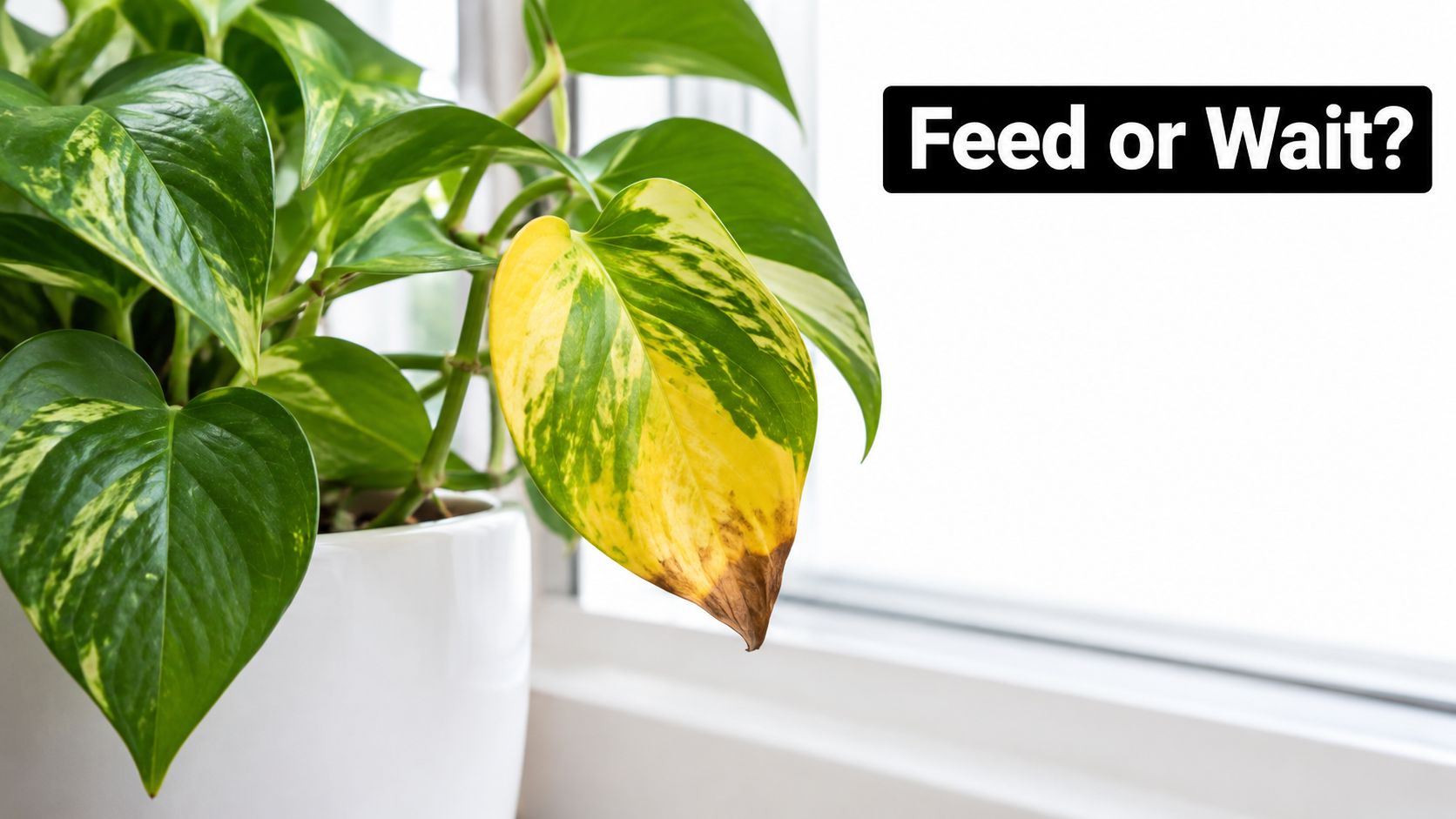
You're watering on a Sunday morning when you spot it. A pothos leaf has turned yellow, your monstera hasn't pushed out new growth in weeks, or a fiddle leaf fig has developed brown edges. Your first thought is probably simple. It must be hungry. Before you reach for a bottle, pause. Good feeding starts with diagnosis, and liquid plant food for houseplants works best when you treat it as a precise input, not a rescue tonic.
That yellow leaf creates a familiar kind of panic. You check the soil, add a little water, then wonder whether a dose of fertilizer will bring the color back. It's an understandable reflex because feeding feels active and helpful, while waiting feels like neglect.
Indoor conditions tell a different story. Your plant lives in a pot with limited soil, indoor light that's often far weaker than it looks to your eyes, and a watering rhythm set by your schedule. Light, moisture, drainage, and pot size usually shape growth before nutrients do, so a slow plant may lack the energy or root space to grow faster.
Feeding a houseplant during dormancy resembles cooking a meal for someone who's asleep. Preparing more food doesn't solve the timing problem, and leaving plates piling up creates a second problem. A plant that isn't actively growing can't use nutrients at the same rate, so unused fertilizer stays in the potting mix as dissolved salts.
Start with questions you can answer in a minute. Is the plant getting enough light for its type? Is the soil dry, evenly moist, or soggy below the surface? Does water drain freely, or does it sit in a saucer or cachepot?
That order matters because each answer changes what you do next. If the plant is thirsty, water it plainly and let it recover. If it's sitting far from light, move it gradually closer and watch for new growth.
Learning how to tell if your plant needs more nutrients before it's too late helps you separate true hunger from these everyday stresses. Once conditions look right and the plant is growing, feeding becomes a useful next step instead of a guess.
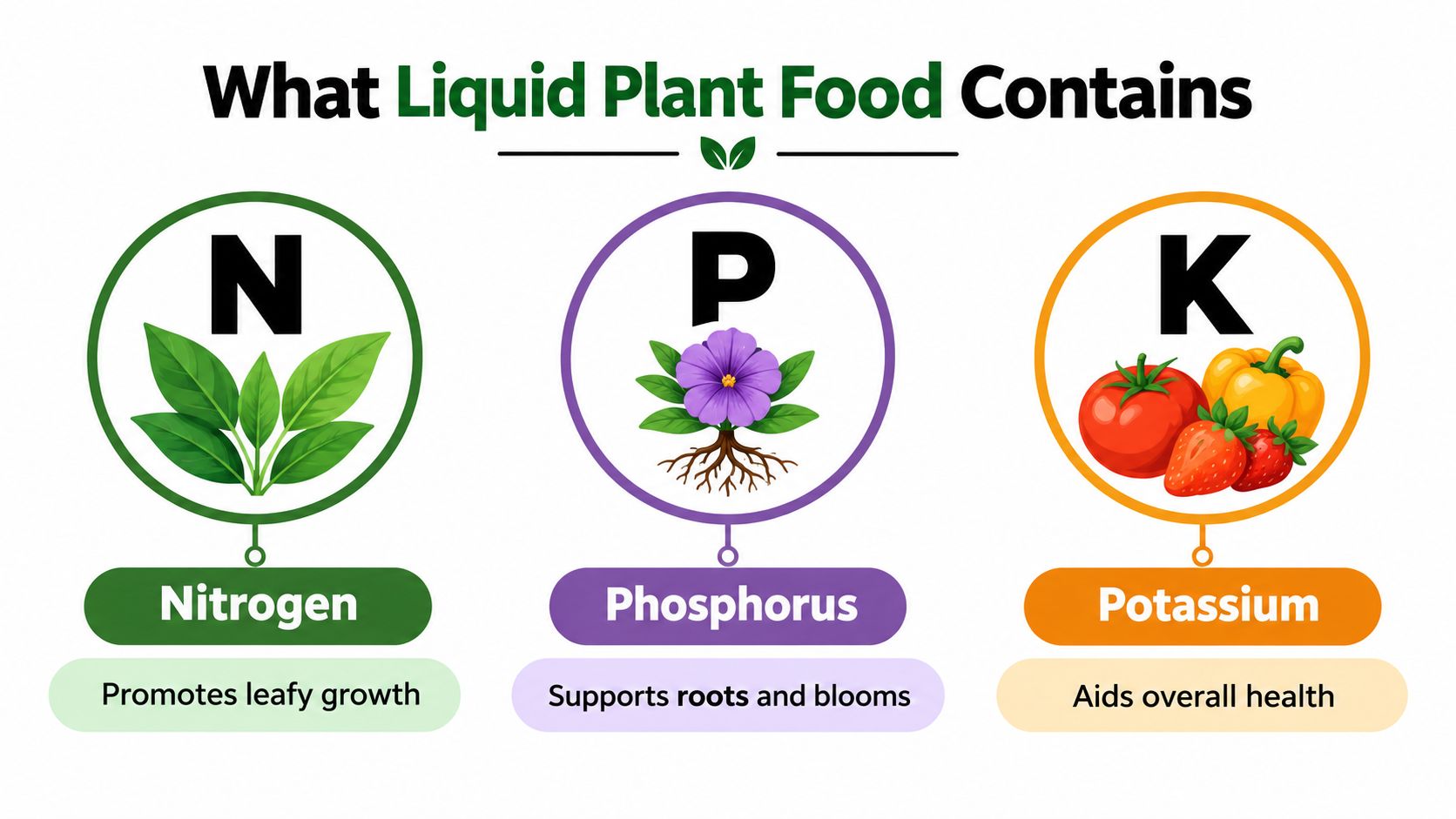
The three numbers on the front of the bottle are the best place to start. They show nitrogen, phosphorus, and potassium, often shortened to N-P-K. Fertilizer labels express them as N–P2O5–K2O, so a 10–5–5 label represents 10% nitrogen, 5% phosphate-equivalent phosphorus, and 5% potash-equivalent potassium by product weight.
Nitrogen supports leafy, green growth. Phosphorus plays a role in roots, flowering, and energy transfer inside the plant. Potassium helps regulate water movement and the internal processes that keep growth steady under stress.
This visual breaks those three roles into a simple map you can picture when you read a label.
Here's the part that removes a lot of confusion. Plants absorb nutrients as ions, and University of Minnesota Extension guidance on how plants take up fertilizer nutrients explains that nitrogen may be taken up as nitrate or ammonium whether it came from an organic or synthetic source. The format can be liquid, granular, pellet, or compost, but the plant still uses the nutrient in ionic form.
A complete formula may also include secondary nutrients such as calcium, magnesium, and sulfur. Trace elements like iron, manganese, zinc, and copper are needed in much smaller amounts, but they still matter for healthy color and normal development. Think of N-P-K as the main meal and micronutrients as small but necessary ingredients you'd notice only when they're missing.
Turn the bottle around and read it like a food label. Look for the guaranteed analysis, the nutrient sources, and the mixing directions. Those details tell you the strength of the concentrate and how much water you need to make a suitable solution.
These nutrients aren't a houseplant marketing invention. FAO fertilizer-use data for 2002 to 2023 reports global agricultural use rising from 142 million tonnes in 2002 to 190 million tonnes in 2023, with nitrogen, phosphorus, and potassium tracked separately because growers manage them for different roles. In a pot, that same separation helps you choose a formula based on what your plant is doing, not chase the biggest numbers.
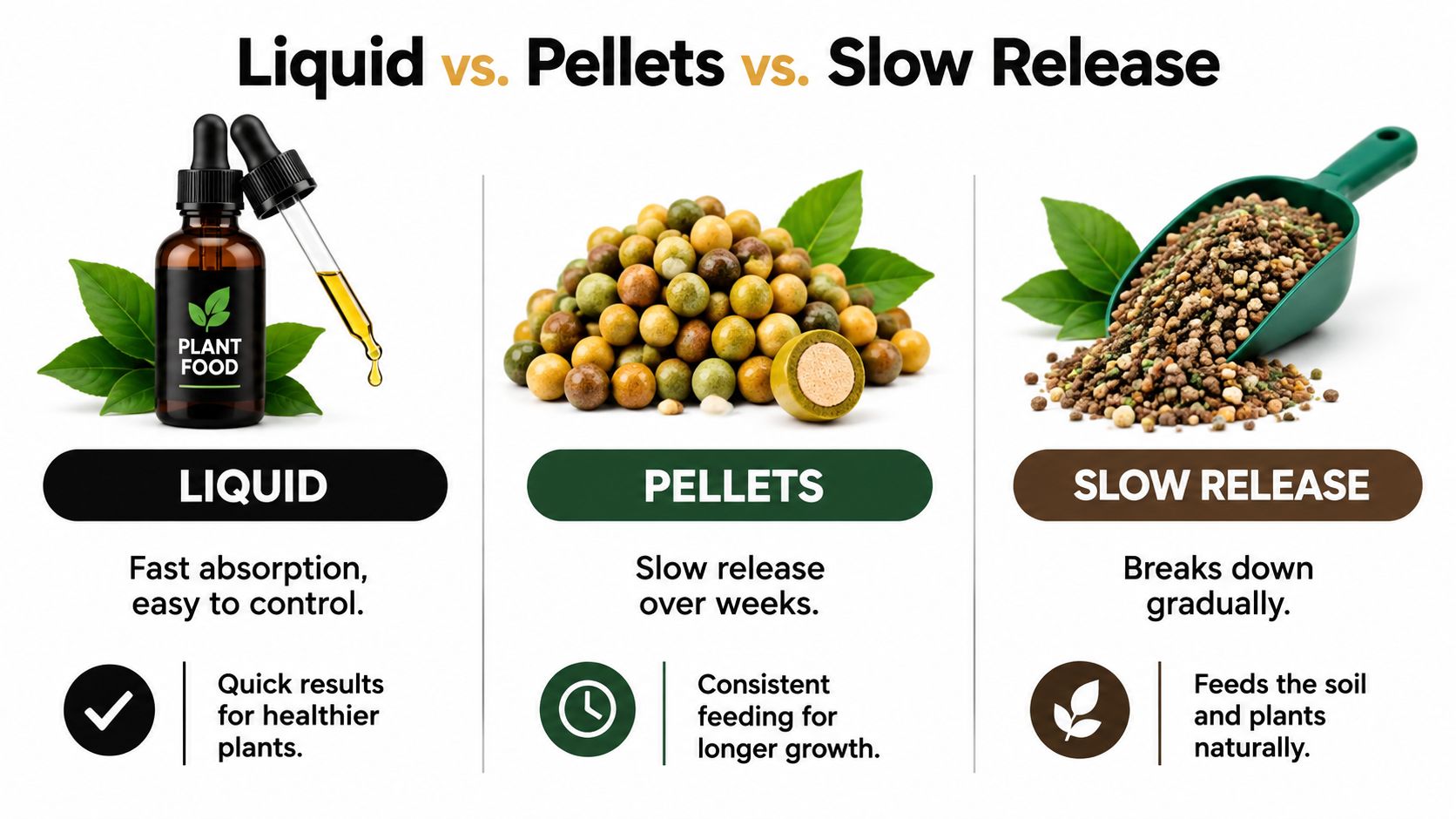
Liquid, pellets, and granular products can supply the same basic nutrients. The main difference is timing and control. A liquid concentrate dissolves in your watering can, spreads through the moist potting mix, and becomes available right away, so you can stop, weaken, or resume feeding as growth changes.
Pellets work more like a timed pantry. Coated slow-release products gradually release nutrients during watering, which suits a steady routine and reduces measuring. Once you've added them, though, you can't easily lower the dose if the plant slows down or moves to lower light.
The comparison below shows the practical trade-offs side by side before you decide what belongs on your shelf.
Liquid feeding also gives you two useful styles. You can apply a very dilute solution during regular watering for a gentle, steady supply, or use a periodic stronger application followed by plain waterings. The dilute approach is easier to keep consistent, while the periodic approach requires more attention to the label and to drainage.
If you're weighing liquid vs pellet fertilizer for your indoor plants, match the format to your habits. Choose liquid if you watch plants closely and like adjusting by season. Choose pellets if you're likely to forget measuring, but avoid stacking pellets and liquid at full strength unless you deliberately account for both.
Dilution is where liquid feeding becomes safe. Measure the concentrate into water exactly as the label directs, mix it before you pour, and apply it evenly across the surface. If you're unsure, choose the weaker end of the label range, because a slow-growing indoor plant can always receive another dilute feed later.
These three steps show the basic sequence from measuring to drainage.
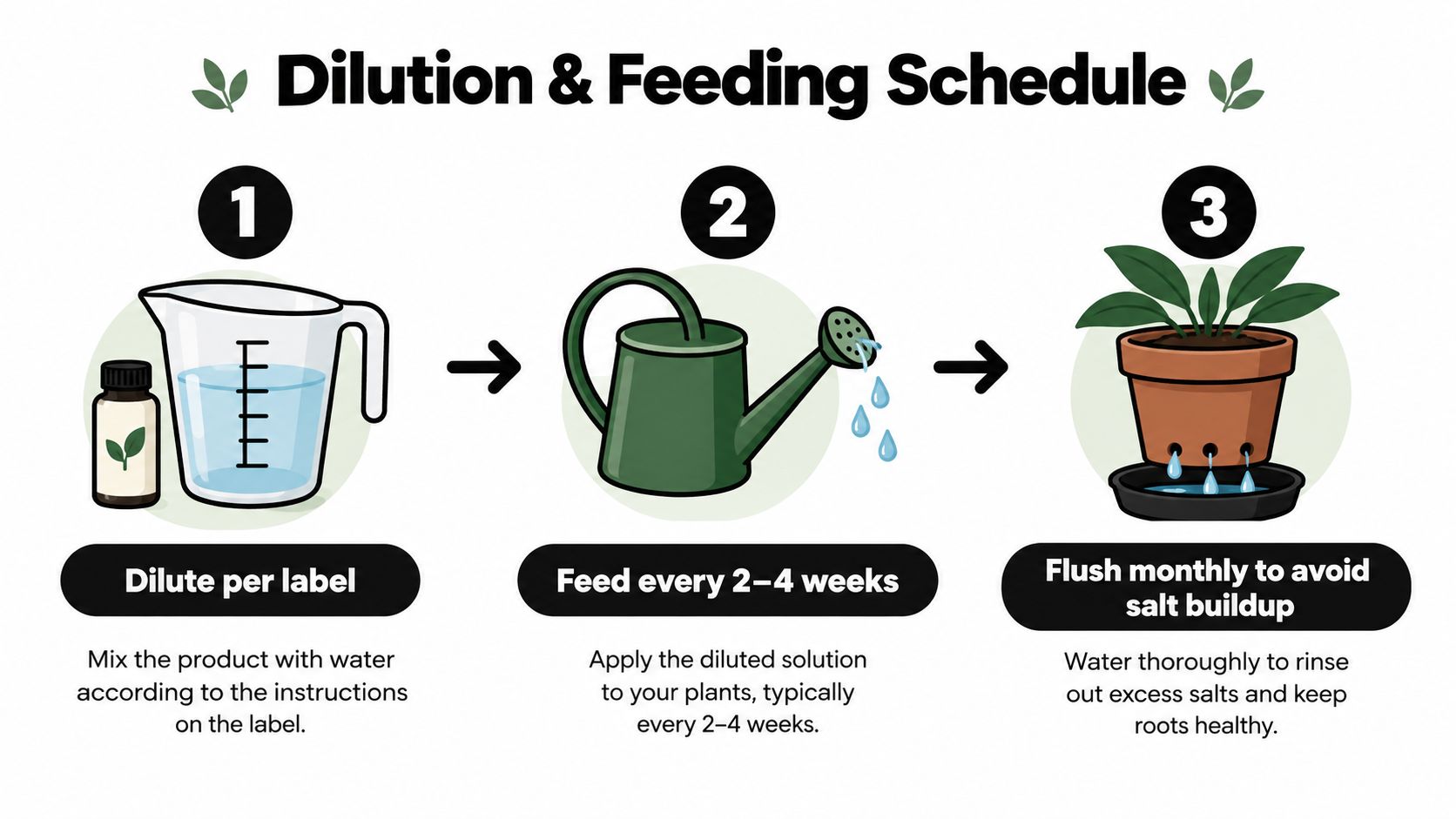
Feed only when you can see active growth, such as new leaves, extending stems, or fresh roots. Water a dry plant with plain water first and let it rehydrate, because roots in dry mix are more vulnerable to a concentrated solution. Don't feed a wilted, dormant, or recently stressed plant until normal watering has stabilized it.
dissolved fertilizer is a salt input. Roots take up some ions, water evaporates from the surface, and the remaining ions become more concentrated in the pot. Over time, that buildup can increase osmotic stress, interfere with water uptake, and show up as white crust, brown margins, wilting, or stalled growth.
Your tap water and watering method can add to the picture. Hard water may contribute dissolved minerals, and repeated bottom watering can leave residues near the surface. That means the same dose can behave differently in a small, warm, fast-drying pot than in a large pot in a cool room.
Purdue Extension guidance on soluble salts in containers describes irrigating until approximately 10–15% of the applied water drains from the container to limit buildup. For a periodic household flush, Lancaster Extension advice on houseplant fertilization and leaching gives leaching with roughly twice the pot volume in water every 4–6 months when drainage is reliable.
This short demonstration is useful for seeing how thoroughly you need to wet and drain the root zone during a flush.
Between flushes, empty saucers after watering and make sure drainage holes stay open. If a decorative cachepot has no hole, water the inner pot at the sink and let it drain before putting it back. That small habit prevents roots from sitting in the most concentrated solution.
A struggling plant isn't automatically a hungry plant. Brown tips, yellowing, wilting, and slow growth share several causes, and fertilizer helps only when a nutrient shortage is limiting growth. If the problem is low light, soggy mix, or salty soil, another dose adds stress to roots that are already struggling.
University of Missouri Extension guidance on houseplant problems identifies poor light and incorrect watering as frequent causes of weak growth, while excess soluble salts can desiccate roots, inhibit water uptake, and cause brown margins, wilting, root dieback, and stunted growth. That overlap is exactly why diagnosis has to come before dosing.
Start at the soil surface. A white or yellowish crust, crusty deposits on the pot rim, or brown leaf edges after regular feeding point you toward salt accumulation. Flush with clear water and pause feeding rather than adding more.
Next, check moisture with your finger or a wooden skewer. Mix that's wet for long periods can suffocate roots and cause yellowing or collapse, even though the plant may look thirsty above ground. Let the appropriate portion dry for that species, improve drainage, and remove standing water.
Then judge light carefully. A plant several feet from a window may receive enough light to survive but not enough to use a strong feed. Move it closer in stages so leaves can adjust, then wait for a growth response.
If several warning signs match, review signs of over-fertilizing plants and how to respond before you mix another solution. The safest test protocol is plain water, corrected conditions, and observation. Resume feeding only when the plant produces healthy new growth and the mix drains normally.
Plant labels become easier once you group your collection by growth style. Leafy tropical plants spend much of their energy making foliage, desert plants grow conservatively, and orchids grow in bark or moss where roots respond differently from roots in dense potting mix. You're not hunting for a magic ratio, you're matching supply to pace.
Monsteras, philodendrons, pothos, and peace lilies generally suit a balanced liquid formula during active growth. Fiddle leaf figs also fit that pattern, but their large leaves make brown edges especially visible when watering or salts go wrong. Keep the solution dilute and consistent, and troubleshoot moisture before assuming a fig needs a stronger feed.
For a general foliage option, Leaves & Soul offers a 3-1-2 liquid concentrate formulated for houseplants and flowers. You'd still dilute it according to its label and adjust the schedule to light and growth, just as you would with any other liquid food.
Succulents and cacti store water and often grow slowly indoors, so they need a lighter hand. Use a weak solution only during active growth, and let excellent drainage do most of the protective work. Soft, stretched growth is a cue to check light and reduce feeding rather than search for a richer formula.
Orchids need dilute feeding because their exposed roots and coarse growing media don't buffer a strong solution in the same way as soil. Wet the roots and medium, apply the weak solution evenly, and flush periodically with clear water. If roots look damaged or the medium has broken down, correct that physical problem before you resume.
Bonsai trees live in restricted root space by design, so small, measured feedings are easier to manage than occasional heavy doses. Their shallow containers also dry and concentrate salts quickly. Watch new shoots, leaf color, and drainage closely, and reduce feeding when growth naturally slows.
When you bring home a new type, begin weaker than you think it needs. A plant can tell you it's ready for more through sustained growth, but it can't remove excess salts on its own.
A workable rhythm follows growth, not a rigid calendar. In spring, watch for new leaves, longer days, and soil that dries a little faster. Begin with a dilute feed once growth is clearly underway, then keep the concentration steady while you observe how each plant responds.
Summer is usually the maintenance phase for plants receiving good light. Continue feeding actively growing plants, water thoroughly, and flush when crust or brown margins appear. If a plant moves outdoors or into much brighter light, don't increase food and light aggressively at the same time, because you won't know which change caused a problem.
As autumn light falls, growth usually slows. Space feedings farther apart, weaken the solution, or stop for plants that have clearly paused. You'll still water according to need, but plain water gives the root zone a break from additional salts.
Winter calls for restraint for most houseplants. A plant under strong grow lights that's still producing leaves may accept an occasional weak feed, while a plant resting beside a dim window usually needs none. Use this quieter period to flush pots that show crust, clear drainage holes, and note which plants will need repotting before spring.
Keep brief notes on your phone if you care for several plant types. Record the formula, dilution, date, and any leaf response you notice later. Those notes turn feeding from a memory test into a pattern you can improve.
The skill you're building isn't memorizing every ratio. It's learning to read light, moisture, roots, and new growth in the right order. When you do that, liquid plant food for houseplants becomes what it should be, a controllable way to supply nutrients at the moment your plant can use them.
Ready to put a calmer feeding rhythm into practice? Browse purpose-built liquid plant foods, soils, and targeted formulas for houseplants, orchids, succulents, and bonsai at Leaves & Soul, then choose one straightforward option that matches the plants you're growing now. Start dilute, watch the new growth, and let your plants show you when they're ready for the next feed.
Why Your Houseplant Might Not Need More Food Yet
That yellow leaf creates a familiar kind of panic. You check the soil, add a little water, then wonder whether a dose of fertilizer will bring the color back. It's an understandable reflex because feeding feels active and helpful, while waiting feels like neglect.
Indoor conditions tell a different story. Your plant lives in a pot with limited soil, indoor light that's often far weaker than it looks to your eyes, and a watering rhythm set by your schedule. Light, moisture, drainage, and pot size usually shape growth before nutrients do, so a slow plant may lack the energy or root space to grow faster.
Feeding a houseplant during dormancy resembles cooking a meal for someone who's asleep. Preparing more food doesn't solve the timing problem, and leaving plates piling up creates a second problem. A plant that isn't actively growing can't use nutrients at the same rate, so unused fertilizer stays in the potting mix as dissolved salts.
The Diagnostic Mindset
Start with questions you can answer in a minute. Is the plant getting enough light for its type? Is the soil dry, evenly moist, or soggy below the surface? Does water drain freely, or does it sit in a saucer or cachepot?
- Check light first: Look at distance from the window and whether new leaves are smaller or widely spaced.
- Check moisture second: Feel the mix below the surface, not just the dry top layer.
- Check the pot third: Look for roots circling drainage holes or water that runs straight through without wetting the mix.
That order matters because each answer changes what you do next. If the plant is thirsty, water it plainly and let it recover. If it's sitting far from light, move it gradually closer and watch for new growth.
Learning how to tell if your plant needs more nutrients before it's too late helps you separate true hunger from these everyday stresses. Once conditions look right and the plant is growing, feeding becomes a useful next step instead of a guess.
Feed a plant that's ready to grow. Don't try to fertilize your way around poor light, wet roots, or a pot that can't drain.
What Liquid Plant Food Actually Contains
The three numbers on the front of the bottle are the best place to start. They show nitrogen, phosphorus, and potassium, often shortened to N-P-K. Fertilizer labels express them as N–P2O5–K2O, so a 10–5–5 label represents 10% nitrogen, 5% phosphate-equivalent phosphorus, and 5% potash-equivalent potassium by product weight.
Nitrogen supports leafy, green growth. Phosphorus plays a role in roots, flowering, and energy transfer inside the plant. Potassium helps regulate water movement and the internal processes that keep growth steady under stress.
This visual breaks those three roles into a simple map you can picture when you read a label.
Here's the part that removes a lot of confusion. Plants absorb nutrients as ions, and University of Minnesota Extension guidance on how plants take up fertilizer nutrients explains that nitrogen may be taken up as nitrate or ammonium whether it came from an organic or synthetic source. The format can be liquid, granular, pellet, or compost, but the plant still uses the nutrient in ionic form.
Beyond the Three Big Numbers
A complete formula may also include secondary nutrients such as calcium, magnesium, and sulfur. Trace elements like iron, manganese, zinc, and copper are needed in much smaller amounts, but they still matter for healthy color and normal development. Think of N-P-K as the main meal and micronutrients as small but necessary ingredients you'd notice only when they're missing.
Turn the bottle around and read it like a food label. Look for the guaranteed analysis, the nutrient sources, and the mixing directions. Those details tell you the strength of the concentrate and how much water you need to make a suitable solution.
These nutrients aren't a houseplant marketing invention. FAO fertilizer-use data for 2002 to 2023 reports global agricultural use rising from 142 million tonnes in 2002 to 190 million tonnes in 2023, with nitrogen, phosphorus, and potassium tracked separately because growers manage them for different roles. In a pot, that same separation helps you choose a formula based on what your plant is doing, not chase the biggest numbers.
How Liquid Feeding Differs From Pellets and Slow Release
Liquid, pellets, and granular products can supply the same basic nutrients. The main difference is timing and control. A liquid concentrate dissolves in your watering can, spreads through the moist potting mix, and becomes available right away, so you can stop, weaken, or resume feeding as growth changes.
Pellets work more like a timed pantry. Coated slow-release products gradually release nutrients during watering, which suits a steady routine and reduces measuring. Once you've added them, though, you can't easily lower the dose if the plant slows down or moves to lower light.
The comparison below shows the practical trade-offs side by side before you decide what belongs on your shelf.
Liquid, Pellets, and Slow Release Compared
| Format | Speed of Effect | Level of Control | Best Use Case |
|---|---|---|---|
| Liquid concentrate | Fast, available in the watering solution | High, because you choose each dilution | Active growth and seasonal adjustment |
| Coated pellets | Gradual during repeated watering | Low after application | Steady maintenance with less measuring |
| Organic granules | Gradual as materials break down | Moderate before application, low afterward | Longer-term soil feeding where breakdown is suitable |
Liquid feeding also gives you two useful styles. You can apply a very dilute solution during regular watering for a gentle, steady supply, or use a periodic stronger application followed by plain waterings. The dilute approach is easier to keep consistent, while the periodic approach requires more attention to the label and to drainage.
If you're weighing liquid vs pellet fertilizer for your indoor plants, match the format to your habits. Choose liquid if you watch plants closely and like adjusting by season. Choose pellets if you're likely to forget measuring, but avoid stacking pellets and liquid at full strength unless you deliberately account for both.
Practical rule: Use one main feeding system at a time. Combining formats without reducing the dose is an easy way to overfeed a container.
Dilution, Schedules, and How to Avoid Salt Buildup
Dilution is where liquid feeding becomes safe. Measure the concentrate into water exactly as the label directs, mix it before you pour, and apply it evenly across the surface. If you're unsure, choose the weaker end of the label range, because a slow-growing indoor plant can always receive another dilute feed later.
These three steps show the basic sequence from measuring to drainage.
Feed only when you can see active growth, such as new leaves, extending stems, or fresh roots. Water a dry plant with plain water first and let it rehydrate, because roots in dry mix are more vulnerable to a concentrated solution. Don't feed a wilted, dormant, or recently stressed plant until normal watering has stabilized it.
Why Salts Accumulate in Pots
dissolved fertilizer is a salt input. Roots take up some ions, water evaporates from the surface, and the remaining ions become more concentrated in the pot. Over time, that buildup can increase osmotic stress, interfere with water uptake, and show up as white crust, brown margins, wilting, or stalled growth.
Your tap water and watering method can add to the picture. Hard water may contribute dissolved minerals, and repeated bottom watering can leave residues near the surface. That means the same dose can behave differently in a small, warm, fast-drying pot than in a large pot in a cool room.
Purdue Extension guidance on soluble salts in containers describes irrigating until approximately 10–15% of the applied water drains from the container to limit buildup. For a periodic household flush, Lancaster Extension advice on houseplant fertilization and leaching gives leaching with roughly twice the pot volume in water every 4–6 months when drainage is reliable.
This short demonstration is useful for seeing how thoroughly you need to wet and drain the root zone during a flush.
Between flushes, empty saucers after watering and make sure drainage holes stay open. If a decorative cachepot has no hole, water the inner pot at the sink and let it drain before putting it back. That small habit prevents roots from sitting in the most concentrated solution.
- Before feeding: Confirm the mix isn't bone dry and the plant is actively growing.
- During feeding: Pour slowly and evenly so the solution reaches the whole root zone.
- After feeding: Let excess drain away and discard it instead of letting the pot reabsorb it indefinitely.
Diagnosing Problems Before You Reach for the Bottle
A struggling plant isn't automatically a hungry plant. Brown tips, yellowing, wilting, and slow growth share several causes, and fertilizer helps only when a nutrient shortage is limiting growth. If the problem is low light, soggy mix, or salty soil, another dose adds stress to roots that are already struggling.
University of Missouri Extension guidance on houseplant problems identifies poor light and incorrect watering as frequent causes of weak growth, while excess soluble salts can desiccate roots, inhibit water uptake, and cause brown margins, wilting, root dieback, and stunted growth. That overlap is exactly why diagnosis has to come before dosing.
A Simple Symptom Check
Start at the soil surface. A white or yellowish crust, crusty deposits on the pot rim, or brown leaf edges after regular feeding point you toward salt accumulation. Flush with clear water and pause feeding rather than adding more.
Next, check moisture with your finger or a wooden skewer. Mix that's wet for long periods can suffocate roots and cause yellowing or collapse, even though the plant may look thirsty above ground. Let the appropriate portion dry for that species, improve drainage, and remove standing water.
Then judge light carefully. A plant several feet from a window may receive enough light to survive but not enough to use a strong feed. Move it closer in stages so leaves can adjust, then wait for a growth response.
- Brown margins with crust: Suspect salts, flush, and review your concentration.
- Yellow leaves with wet mix: Suspect roots and watering before nitrogen.
- No growth in dim conditions: Improve light before increasing fertilizer.
- Pale new growth in good light: Consider a dilute feed after the other checks pass.
If several warning signs match, review signs of over-fertilizing plants and how to respond before you mix another solution. The safest test protocol is plain water, corrected conditions, and observation. Resume feeding only when the plant produces healthy new growth and the mix drains normally.
A plant that wilts in salty, moist soil may be unable to drink. More fertilizer makes that water harder for roots to use, not easier.
Matching the Formula to Common Houseplants
Plant labels become easier once you group your collection by growth style. Leafy tropical plants spend much of their energy making foliage, desert plants grow conservatively, and orchids grow in bark or moss where roots respond differently from roots in dense potting mix. You're not hunting for a magic ratio, you're matching supply to pace.
Leafy and Large Plants
Monsteras, philodendrons, pothos, and peace lilies generally suit a balanced liquid formula during active growth. Fiddle leaf figs also fit that pattern, but their large leaves make brown edges especially visible when watering or salts go wrong. Keep the solution dilute and consistent, and troubleshoot moisture before assuming a fig needs a stronger feed.
For a general foliage option, Leaves & Soul offers a 3-1-2 liquid concentrate formulated for houseplants and flowers. You'd still dilute it according to its label and adjust the schedule to light and growth, just as you would with any other liquid food.
Succulents, Cacti, Orchids, and Bonsai
Succulents and cacti store water and often grow slowly indoors, so they need a lighter hand. Use a weak solution only during active growth, and let excellent drainage do most of the protective work. Soft, stretched growth is a cue to check light and reduce feeding rather than search for a richer formula.
Orchids need dilute feeding because their exposed roots and coarse growing media don't buffer a strong solution in the same way as soil. Wet the roots and medium, apply the weak solution evenly, and flush periodically with clear water. If roots look damaged or the medium has broken down, correct that physical problem before you resume.
Bonsai trees live in restricted root space by design, so small, measured feedings are easier to manage than occasional heavy doses. Their shallow containers also dry and concentrate salts quickly. Watch new shoots, leaf color, and drainage closely, and reduce feeding when growth naturally slows.
- Fast leafy growers: Balanced feed, adjusted to visible growth.
- Slow desert plants: Weak feed, used sparingly in the growing phase.
- Orchids and bonsai: Dilute feed with careful flushing and close root observation.
When you bring home a new type, begin weaker than you think it needs. A plant can tell you it's ready for more through sustained growth, but it can't remove excess salts on its own.
Your Simple Feeding Rhythm for the Year
A workable rhythm follows growth, not a rigid calendar. In spring, watch for new leaves, longer days, and soil that dries a little faster. Begin with a dilute feed once growth is clearly underway, then keep the concentration steady while you observe how each plant responds.
Summer is usually the maintenance phase for plants receiving good light. Continue feeding actively growing plants, water thoroughly, and flush when crust or brown margins appear. If a plant moves outdoors or into much brighter light, don't increase food and light aggressively at the same time, because you won't know which change caused a problem.
Tapering and Resting
As autumn light falls, growth usually slows. Space feedings farther apart, weaken the solution, or stop for plants that have clearly paused. You'll still water according to need, but plain water gives the root zone a break from additional salts.
Winter calls for restraint for most houseplants. A plant under strong grow lights that's still producing leaves may accept an occasional weak feed, while a plant resting beside a dim window usually needs none. Use this quieter period to flush pots that show crust, clear drainage holes, and note which plants will need repotting before spring.
- Dilute precisely: Measure instead of estimating with a splash from the bottle.
- Feed growth: Look for new leaves or shoots before you mix a solution.
- Protect roots: Never apply concentrate to a bone-dry or wilted plant.
- Flush periodically: Use clear water and full drainage when residues build up.
Keep brief notes on your phone if you care for several plant types. Record the formula, dilution, date, and any leaf response you notice later. Those notes turn feeding from a memory test into a pattern you can improve.
The skill you're building isn't memorizing every ratio. It's learning to read light, moisture, roots, and new growth in the right order. When you do that, liquid plant food for houseplants becomes what it should be, a controllable way to supply nutrients at the moment your plant can use them.
Ready to put a calmer feeding rhythm into practice? Browse purpose-built liquid plant foods, soils, and targeted formulas for houseplants, orchids, succulents, and bonsai at Leaves & Soul, then choose one straightforward option that matches the plants you're growing now. Start dilute, watch the new growth, and let your plants show you when they're ready for the next feed.