L
Lisa Mays
Guest
- Thread Author
- #1
You're in the garden center with a bottle in one hand and your phone in the other. One label says 2-7-7, another says 10-10-10, and both look plausible. The right choice depends on more than which set of numbers looks most cactus-friendly. It depends on what those numbers represent, how much fertilizer you mix into the water, and whether your plant is actively growing.
A useful rule to keep in mind is this: the ratio describes the fertilizer's concentration, not the dose your cactus receives. Once you can separate those ideas, you can read the label with more confidence and feed more cautiously.
Fertilizer labels use three numbers in a fixed order: nitrogen (N), phosphorus (P), and potassium (K). A bottle marked 2-7-7 lists those nutrients in that sequence. The numbers aren't a marketing code that changes from one brand to another. They're the label's shorthand for the product's N-P-K analysis.

A second detail can make the label harder to interpret. Fertilizer labels generally express phosphorus as phosphate, or P₂O₅, and potassium as potash, or K₂O, rather than as elemental phosphorus and potassium. So a label reading 20-20-20 means 20% nitrogen, 20% phosphate, and 20% potash by the label convention, not three equal percentages of the elements themselves. This guide to fertilizer numbers can help you get comfortable reading the shorthand.
The next step is the one people often miss: those numbers describe concentration in the product, not the amount your plant gets in one watering. The dose changes with how much product you add to the water. That's why a concentrated balanced fertilizer can be used cautiously when diluted, while a low-nitrogen fertilizer can still be too strong if you apply it at full strength.
Say the sequence aloud when you pick up a bottle: nitrogen, phosphorus, potassium. Then check the mixing directions before deciding whether the product fits your cactus.
The letters on a fertilizer bottle stand for nutrients plants use in different ways. For a cactus grower, the helpful question isn't just “Which nutrient is in the mix?” It's “What might this nutrient do to the plant I can see?”
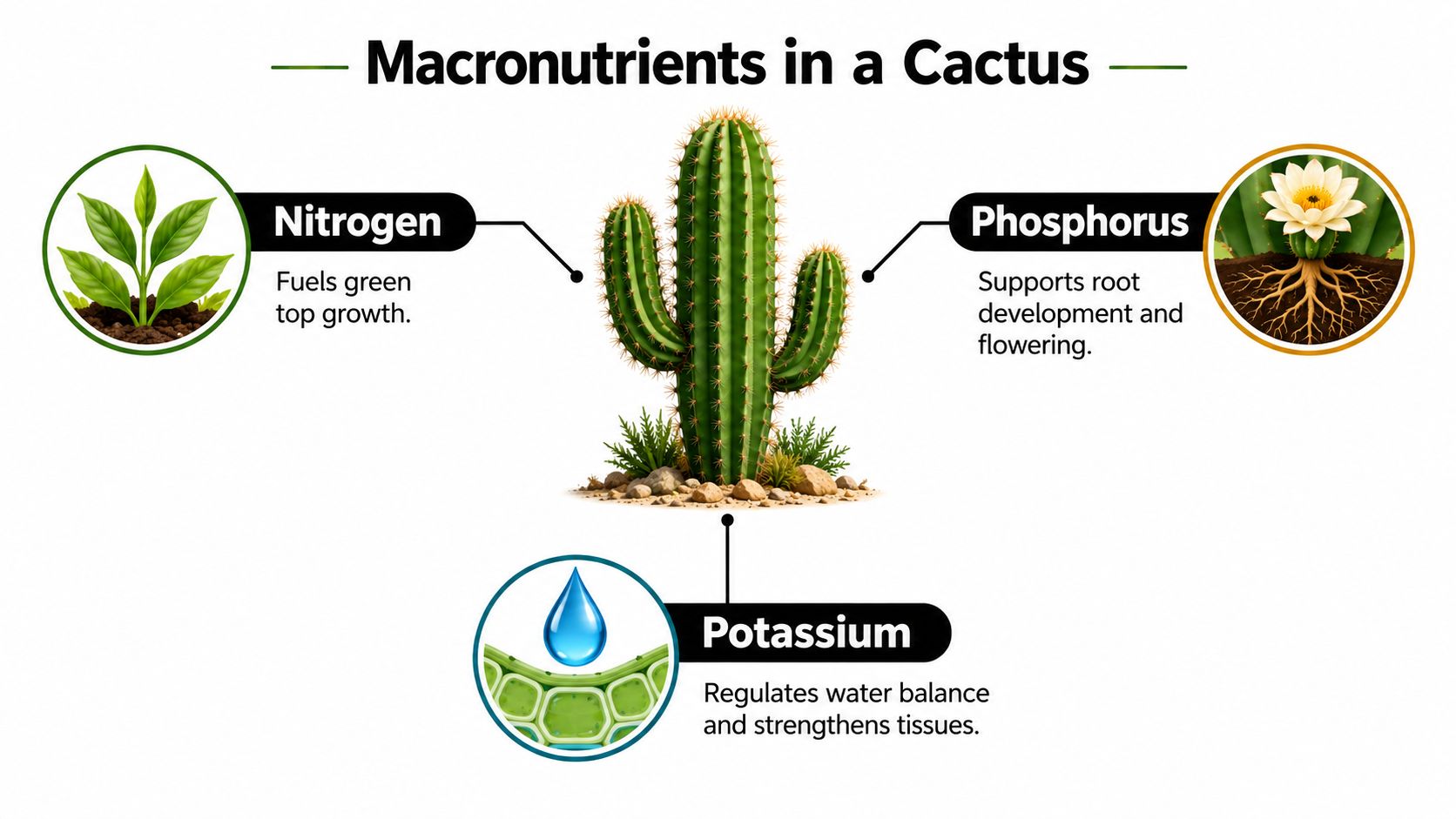
Think of the three nutrients as separate dials rather than a single “feed me” switch. Each one pushes a different kind of growth, and your cactus responds to each dial on its own.
Nitrogen supports green top growth. Too much can encourage soft, elongated growth rather than the compact shape many cactus owners want. For a low-nitrogen example, a 2-7-7 label gives nitrogen a smaller displayed number than phosphorus and potassium. In the label numbers, each of those other nutrients is 3.5 times the nitrogen figure, which reflects a conventional effort to keep nitrogen restrained for many cacti. University of Minnesota Extension guidance on growing cacti and succulents describes this cautious feeding approach and the value of diluting feeds.
Phosphorus is associated with root development and flowering. A cactus that doesn't bloom isn't automatically asking for more phosphorus, though. Light, water, and the health of the roots all matter, so a fertilizer change alone may not address the problem.
Potassium plays a role in water balance and tissue function. If your plant looks weak or its growth seems off, don't treat a visual symptom as a nutrient diagnosis on its own. Similar signs can arise from care conditions, and adding fertilizer without checking those conditions can make matters worse.
Cacti evolved in relatively low-nutrient environments. A restrained feeding routine is generally more appropriate than trying to push rapid, lush growth. Look at the plant and its conditions before reaching for a bottle, and change one care variable at a time.
Read a fertilizer ratio the way you would read a recipe. The three numbers are parts in a mixture inside the bottle. The dose that reaches the roots is a separate question, decided by how much product you stir into the water. Two bottles with very different figures can end up delivering similar doses, which is why the shape of a label matters more than the size of its numbers.
Nearly every cactus fertilizer on the shelf falls into one of three label shapes.
The first keeps nitrogen deliberately small. That restrained pattern is a common starting point for desert cacti, because it suits the conventional aim of feeding lightly while avoiding growth that turns soft or stretched.
The second shows three equal numbers. "Balanced" describes the recipe inside the bottle, while the dose that reaches the pot remains a separate question. At full strength, an equal-parts product can still supply more nutrient than a small pot needs, so this family fits a mixed succulent collection only when diluted well below the label rate.
The third pushes the middle number highest. Products in this group are often sold as bloom boosters, yet the label alone cannot tell you whether a plant that refuses to flower lacks phosphorus or lacks light. A high middle figure is a claim to weigh before you buy.
Plants sold as cacti do not all share the same needs. A desert barrel cactus, an edible Opuntia, and a holiday cactus differ in growth habit and growing conditions, so identifying your plant and its growing season comes before choosing a bottle.
These ratios and dilution notes reflect general recommendations for home-grown cacti and succulents, and individual plants can fall outside them. As noted earlier, published guidance favors a low-nitrogen approach and reduced application rates, and any of the three families can still harm a plant when the dose behind the ratio is too strong.
To compare fertilizers, start with the nitrogen concentration on the label, then account for how much product you mix into the water. A 2-7-7 liquid fertilizer contains 2% nitrogen by label analysis. But the label alone doesn't tell you how many milligrams of nitrogen will end up in each liter of water, because you also need the product's density and the exact mixing rate.
That's why a simple shortcut can be misleading. Multiplying the first number by ten may give a rough concentration in milligrams per liter only under specific assumptions about the product and dilution. Without the label's rate and product details, there isn't enough information to calculate a reliable number for nitrogen per watering.
Instead, compare products using the information the bottle provides:
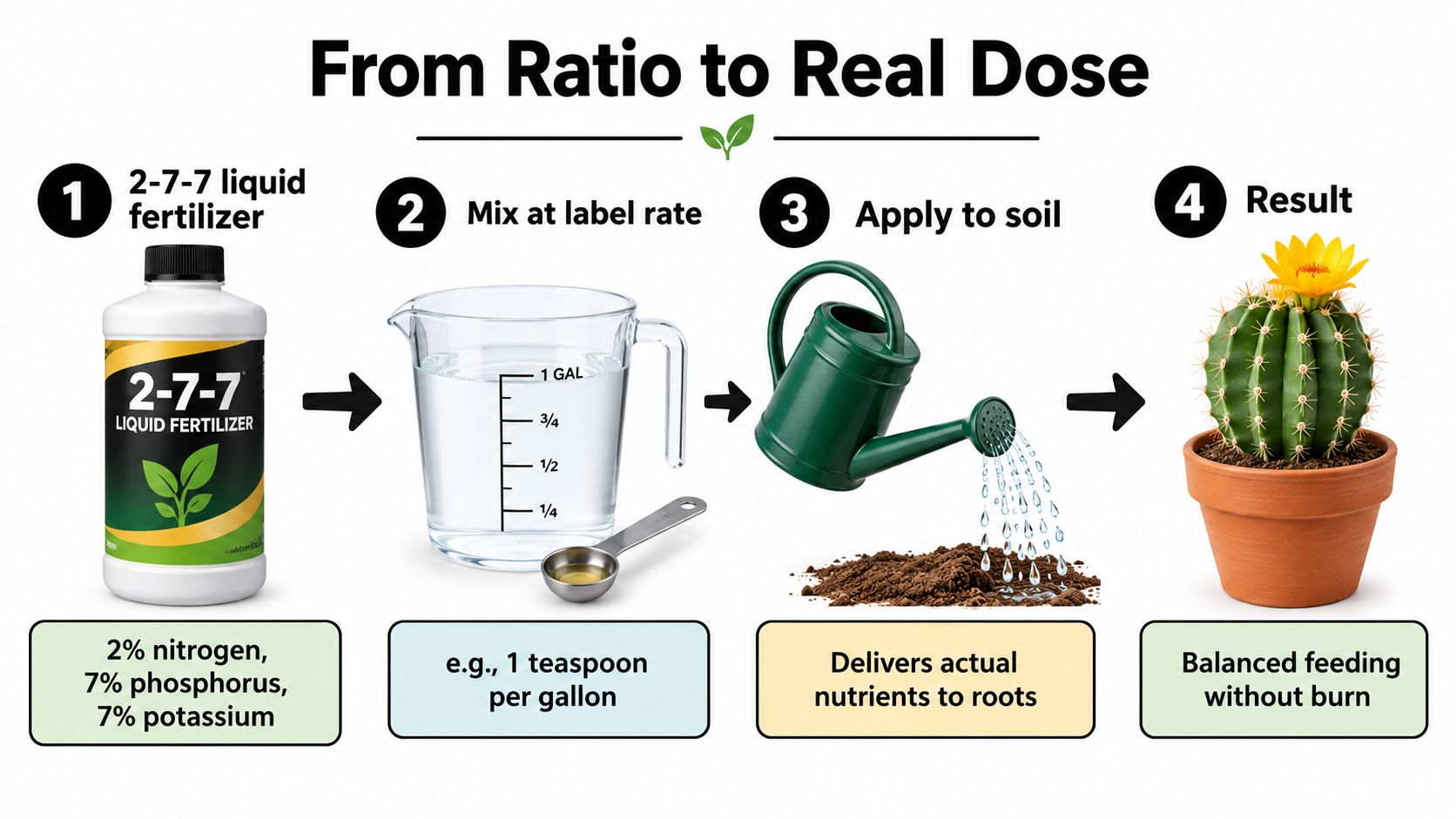
Liquid fertilizer reaches the roots in a watering, while granular and slow-release products release nutrients differently. Don't assume the same ratio means the same feeding pattern across these forms. Compare the product's directions and use a measuring tool, rather than estimating by eye. This guide to fertilizer application rates offers further help with applying fertilizer carefully.
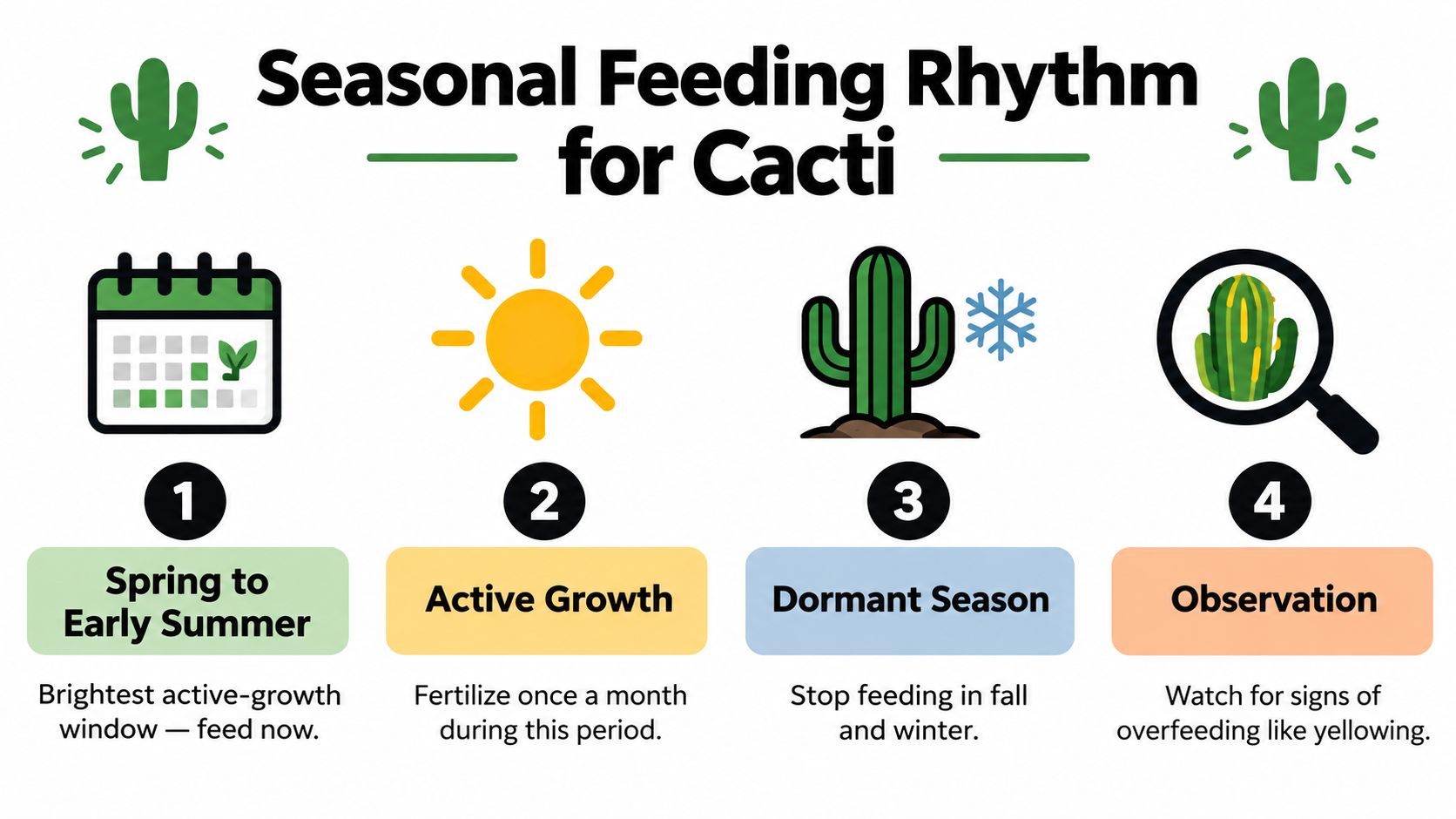
Feed according to the plant's growth, not a fixed monthly reminder. A cactus can only use nutrients while it is actively growing, so what the plant is doing matters more than what the calendar says. Bright light and visible new growth signal a plant ready for a diluted feed. Dim conditions and stalled growth signal a plant that will sit in fertilizer it cannot use.
For many home-grown cacti, one or two applications across the growing season is usually enough; the half-strength dilution described above applies here too. Other succulents may receive roughly three or four applications over that same broad period. Treat these as general ranges, not a schedule every plant must follow.
Labels rarely tell you this. When a bottle says "feed monthly," it is describing the manufacturer's maximum, not your cactus's requirement, so read frequency claims on the packaging the same way you read the mixing rate.
A simple seasonal check can help you decide:
A holiday cactus needs a different conversation from a desert cactus because the plants differ in their growing habits. Don't apply a desert-cactus schedule automatically to every plant sold under the cactus name. Before feeding, ask whether the plant is actively growing, whether it has enough light, and whether it has recently been repotted.
A higher middle number doesn't guarantee more flowers. Phosphorus supports root development and flowering, but it can't make up for poor light, unsuitable growing conditions, or unhealthy roots. If your cactus isn't blooming, first check those basics before switching to a phosphorus-heavy fertilizer.
Evidence from cultivated cactus crops also cautions against treating one ratio as universally superior. A study of forage cactus intercropping reported that the nitrogen level associated with the strongest response differed between cactus-pigeon-pea and cactus-sorghum systems. Other forage-cactus research described production gains under a particular combination of nitrogen and phosphorus. These results concern agricultural cultivation for biomass, not potted ornamental cacti, but they show why growing context matters. Research on forage cactus fertilization illustrates how field-crop nutrient programs differ from home plant care.
The same caution applies to balanced fertilizer. A product such as 20-20-20 isn't automatically harmless just because all three label numbers match. The concentration still matters, and the applied amount depends on how the product is mixed. A low-number ratio can also be overused if you apply too much or feed too often.
Repeated high-phosphorus feeding can also add nutrients a container plant doesn't need and contribute to salt buildup. A balanced, diluted feed during active growth is a more defensible starting point than chasing the largest middle number. Research discussing balanced fertilization in cactus pear provides context for why phosphorus-heavy formulas shouldn't be assumed to be uniquely effective.
The large N-P-K numbers aren't the entire label. Check the directions, nutrient analysis, and the form of the product before you use it. If the label includes secondary nutrients or micronutrients, treat them as part of the overall formula, not as a reason to increase the dose. For products in granular, pellet, or liquid form, follow the instructions for that specific product rather than assuming they can be measured or applied the same way.
Watch the plant and the soil after feeding. Soft, unusually stretched growth can signal that the plant is receiving more nitrogen than it can use well. A white crust on the soil surface can indicate mineral or salt accumulation, while a pot that stays wet longer than expected may point to a separate problem with watering, drainage, or root health.
If you suspect overfeeding, stop adding fertilizer and inspect the plant and potting mix. If the product is water-soluble and the pot drains freely, plain water can help rinse salts through the substrate. If the soil has a heavy crust or the mix holds salts and moisture, consider replacing it with fresh, well-draining substrate rather than adding more water to an already wet pot.
Don't rely on one symptom to diagnose fertilizer damage. Check whether the cactus is receiving appropriate light, whether water drains freely, and whether the roots appear healthy. For a broader overview of warning signs, see this guide to signs of over-fertilizing plants.
Before choosing a fertilizer, pause at the label and check the whole setup, not just the three numbers.
Start conservatively, then observe how your cactus responds to its light, water, and substrate. The ratio matters, but it's one part of the care routine, not a substitute for suitable growing conditions.
Leaves & Soul offers purpose-built soils, fertilizers, and gardening accessories, including succulent fertilizer pellets labeled for cacti and other succulents. If you're comparing products for your collection, visit Leaves & Soul to explore its plant-care range.
A useful rule to keep in mind is this: the ratio describes the fertilizer's concentration, not the dose your cactus receives. Once you can separate those ideas, you can read the label with more confidence and feed more cautiously.
Why the Numbers on the Bottle Feel So Confusing
Fertilizer labels use three numbers in a fixed order: nitrogen (N), phosphorus (P), and potassium (K). A bottle marked 2-7-7 lists those nutrients in that sequence. The numbers aren't a marketing code that changes from one brand to another. They're the label's shorthand for the product's N-P-K analysis.
A second detail can make the label harder to interpret. Fertilizer labels generally express phosphorus as phosphate, or P₂O₅, and potassium as potash, or K₂O, rather than as elemental phosphorus and potassium. So a label reading 20-20-20 means 20% nitrogen, 20% phosphate, and 20% potash by the label convention, not three equal percentages of the elements themselves. This guide to fertilizer numbers can help you get comfortable reading the shorthand.
The next step is the one people often miss: those numbers describe concentration in the product, not the amount your plant gets in one watering. The dose changes with how much product you add to the water. That's why a concentrated balanced fertilizer can be used cautiously when diluted, while a low-nitrogen fertilizer can still be too strong if you apply it at full strength.
Keep this sentence handy: The label tells me what's in the fertilizer; my mixing rate determines what reaches the plant.
Say the sequence aloud when you pick up a bottle: nitrogen, phosphorus, potassium. Then check the mixing directions before deciding whether the product fits your cactus.
What Nitrogen, Phosphorus, and Potassium Do in a Cactus
The letters on a fertilizer bottle stand for nutrients plants use in different ways. For a cactus grower, the helpful question isn't just “Which nutrient is in the mix?” It's “What might this nutrient do to the plant I can see?”
Think of the three nutrients as separate dials rather than a single “feed me” switch. Each one pushes a different kind of growth, and your cactus responds to each dial on its own.
Nitrogen supports green top growth. Too much can encourage soft, elongated growth rather than the compact shape many cactus owners want. For a low-nitrogen example, a 2-7-7 label gives nitrogen a smaller displayed number than phosphorus and potassium. In the label numbers, each of those other nutrients is 3.5 times the nitrogen figure, which reflects a conventional effort to keep nitrogen restrained for many cacti. University of Minnesota Extension guidance on growing cacti and succulents describes this cautious feeding approach and the value of diluting feeds.
Phosphorus is associated with root development and flowering. A cactus that doesn't bloom isn't automatically asking for more phosphorus, though. Light, water, and the health of the roots all matter, so a fertilizer change alone may not address the problem.
Potassium plays a role in water balance and tissue function. If your plant looks weak or its growth seems off, don't treat a visual symptom as a nutrient diagnosis on its own. Similar signs can arise from care conditions, and adding fertilizer without checking those conditions can make matters worse.
Cacti evolved in relatively low-nutrient environments. A restrained feeding routine is generally more appropriate than trying to push rapid, lush growth. Look at the plant and its conditions before reaching for a bottle, and change one care variable at a time.
Comparing the Most Common Cactus Fertilizer Ratios
Read a fertilizer ratio the way you would read a recipe. The three numbers are parts in a mixture inside the bottle. The dose that reaches the roots is a separate question, decided by how much product you stir into the water. Two bottles with very different figures can end up delivering similar doses, which is why the shape of a label matters more than the size of its numbers.
Nearly every cactus fertilizer on the shelf falls into one of three label shapes.
The first keeps nitrogen deliberately small. That restrained pattern is a common starting point for desert cacti, because it suits the conventional aim of feeding lightly while avoiding growth that turns soft or stretched.
The second shows three equal numbers. "Balanced" describes the recipe inside the bottle, while the dose that reaches the pot remains a separate question. At full strength, an equal-parts product can still supply more nutrient than a small pot needs, so this family fits a mixed succulent collection only when diluted well below the label rate.
The third pushes the middle number highest. Products in this group are often sold as bloom boosters, yet the label alone cannot tell you whether a plant that refuses to flower lacks phosphorus or lacks light. A high middle figure is a claim to weigh before you buy.
Plants sold as cacti do not all share the same needs. A desert barrel cactus, an edible Opuntia, and a holiday cactus differ in growth habit and growing conditions, so identifying your plant and its growing season comes before choosing a bottle.
| Ratio family | Best for | Typical dilution | Risk if overused |
|---|---|---|---|
| Low nitrogen (N below P and K, e.g. 2-7-7 or 2-8-8) | Many home-grown desert cacti | Follow the label, then consider reducing to about half strength | Excess feeding can still cause problems, even with a restrained nitrogen ratio |
| Balanced (three equal numbers, e.g. 10-10-10) | A cautious option for mixed succulent collections | Dilute substantially, using about half the label rate as a starting point | A full-strength dose may deliver more nutrients than a potted cactus needs |
| Higher phosphorus (middle number largest, e.g. 5-10-10) | Plants being considered for a flowering-focused feed | Use only as directed and avoid frequent applications | Repeated use can add unnecessary nutrients and salts to a small pot |
These ratios and dilution notes reflect general recommendations for home-grown cacti and succulents, and individual plants can fall outside them. As noted earlier, published guidance favors a low-nitrogen approach and reduced application rates, and any of the three families can still harm a plant when the dose behind the ratio is too strong.
How to Translate a Ratio into a Real Feeding Dose
To compare fertilizers, start with the nitrogen concentration on the label, then account for how much product you mix into the water. A 2-7-7 liquid fertilizer contains 2% nitrogen by label analysis. But the label alone doesn't tell you how many milligrams of nitrogen will end up in each liter of water, because you also need the product's density and the exact mixing rate.
That's why a simple shortcut can be misleading. Multiplying the first number by ten may give a rough concentration in milligrams per liter only under specific assumptions about the product and dilution. Without the label's rate and product details, there isn't enough information to calculate a reliable number for nitrogen per watering.
Instead, compare products using the information the bottle provides:
- Read the N-P-K analysis. Note the first number, which represents nitrogen concentration.
- Check the labeled mixing rate. Find the specified amount of product for the volume of water you'll use.
- Reduce the dose cautiously. For many home-grown cacti and succulents, guidance recommends about half the label rate, with further dilution for sensitive plants.
- Match the application to the plant. A small pot and slow-growing cactus generally call for a more conservative approach than a vigorous plant growing in a larger container.
Liquid fertilizer reaches the roots in a watering, while granular and slow-release products release nutrients differently. Don't assume the same ratio means the same feeding pattern across these forms. Compare the product's directions and use a measuring tool, rather than estimating by eye. This guide to fertilizer application rates offers further help with applying fertilizer carefully.
When and How Often to Feed Your Cactus
Feed according to the plant's growth, not a fixed monthly reminder. A cactus can only use nutrients while it is actively growing, so what the plant is doing matters more than what the calendar says. Bright light and visible new growth signal a plant ready for a diluted feed. Dim conditions and stalled growth signal a plant that will sit in fertilizer it cannot use.
For many home-grown cacti, one or two applications across the growing season is usually enough; the half-strength dilution described above applies here too. Other succulents may receive roughly three or four applications over that same broad period. Treat these as general ranges, not a schedule every plant must follow.
Labels rarely tell you this. When a bottle says "feed monthly," it is describing the manufacturer's maximum, not your cactus's requirement, so read frequency claims on the packaging the same way you read the mixing rate.
A simple seasonal check can help you decide:
- Spring and early summer: If the cactus is growing and getting bright light, consider a diluted feed.
- During active growth: Keep the total number of applications modest. Don't add fertilizer every time you water.
- When growth slows or light drops: Skip feeding until the plant resumes active growth.
- After repotting: Let the plant settle into its new substrate before adding fertilizer.
A holiday cactus needs a different conversation from a desert cactus because the plants differ in their growing habits. Don't apply a desert-cactus schedule automatically to every plant sold under the cactus name. Before feeding, ask whether the plant is actively growing, whether it has enough light, and whether it has recently been repotted.
The Phosphorus Trap and Other Ratio Misconceptions
A higher middle number doesn't guarantee more flowers. Phosphorus supports root development and flowering, but it can't make up for poor light, unsuitable growing conditions, or unhealthy roots. If your cactus isn't blooming, first check those basics before switching to a phosphorus-heavy fertilizer.
Evidence from cultivated cactus crops also cautions against treating one ratio as universally superior. A study of forage cactus intercropping reported that the nitrogen level associated with the strongest response differed between cactus-pigeon-pea and cactus-sorghum systems. Other forage-cactus research described production gains under a particular combination of nitrogen and phosphorus. These results concern agricultural cultivation for biomass, not potted ornamental cacti, but they show why growing context matters. Research on forage cactus fertilization illustrates how field-crop nutrient programs differ from home plant care.
The same caution applies to balanced fertilizer. A product such as 20-20-20 isn't automatically harmless just because all three label numbers match. The concentration still matters, and the applied amount depends on how the product is mixed. A low-number ratio can also be overused if you apply too much or feed too often.
More phosphorus isn't a shortcut to blooms. Check the plant's growing conditions before you change the fertilizer.
Repeated high-phosphorus feeding can also add nutrients a container plant doesn't need and contribute to salt buildup. A balanced, diluted feed during active growth is a more defensible starting point than chasing the largest middle number. Research discussing balanced fertilization in cactus pear provides context for why phosphorus-heavy formulas shouldn't be assumed to be uniquely effective.
Reading the Label and Spotting Overfeeding Early
The large N-P-K numbers aren't the entire label. Check the directions, nutrient analysis, and the form of the product before you use it. If the label includes secondary nutrients or micronutrients, treat them as part of the overall formula, not as a reason to increase the dose. For products in granular, pellet, or liquid form, follow the instructions for that specific product rather than assuming they can be measured or applied the same way.
Watch the plant and the soil after feeding. Soft, unusually stretched growth can signal that the plant is receiving more nitrogen than it can use well. A white crust on the soil surface can indicate mineral or salt accumulation, while a pot that stays wet longer than expected may point to a separate problem with watering, drainage, or root health.
If you suspect overfeeding, stop adding fertilizer and inspect the plant and potting mix. If the product is water-soluble and the pot drains freely, plain water can help rinse salts through the substrate. If the soil has a heavy crust or the mix holds salts and moisture, consider replacing it with fresh, well-draining substrate rather than adding more water to an already wet pot.
Don't rely on one symptom to diagnose fertilizer damage. Check whether the cactus is receiving appropriate light, whether water drains freely, and whether the roots appear healthy. For a broader overview of warning signs, see this guide to signs of over-fertilizing plants.
Your Quick Reference Checklist Before You Buy
Before choosing a fertilizer, pause at the label and check the whole setup, not just the three numbers.
- Read beyond N-P-K. Check the mixing directions and whether the product is liquid, granular, or slow-release.
- Match the ratio to the plant. A low-nitrogen formula is a common starting point for many desert cacti. Don't assume every cactus, succulent, or holiday plant has identical needs.
- Choose a cautious dose and time. Feed only during brighter active growth. For many home-grown cacti, guidance favors about half the label rate and only limited applications across the season.
- Look for early warning signs. Soft, elongated growth or a crust on the soil means it's time to stop and reassess the dose and growing conditions.
Start conservatively, then observe how your cactus responds to its light, water, and substrate. The ratio matters, but it's one part of the care routine, not a substitute for suitable growing conditions.
Leaves & Soul offers purpose-built soils, fertilizers, and gardening accessories, including succulent fertilizer pellets labeled for cacti and other succulents. If you're comparing products for your collection, visit Leaves & Soul to explore its plant-care range.