
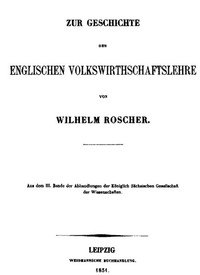
Zur Geschichte der englischen Volkswirthschaftslehre by Wilhelm Roscher
Let's be clear: this is not a beach read. Published in 1851, Wilhelm Roscher's book is a serious, scholarly work written in German. But don't let that scare you off from understanding what it's about. Think of it as a grand intellectual biography of a nation's economic conscience.
The Story
Roscher doesn't tell a story with characters and plot twists. Instead, he maps the evolution of economic thinking in England. He starts way back, looking at how medieval and early modern writers viewed things like property, usury (lending money with interest), and the role of the state in the economy. The book then builds toward its climax: the 18th century and the birth of classical political economy with giants like Adam Smith, David Ricardo, and Thomas Malthus. Roscher examines their core ideas about free markets, value, and population. Finally, he brings the story up to his present day, looking at the debates and new challenges facing economic thought in the industrial age. The 'plot' is the argument itself—how one set of ideas led to another, and how they all responded to the real-world changes happening outside the thinkers' windows.
Why You Should Read It
What's compelling is Roscher's perspective. He was a founder of the German Historical School, which believed you couldn't understand economics without understanding history and culture. So, he's not just listing theories; he's trying to show how English ideas grew from England's unique history. Reading about his analysis reminds you that economics was never just about math and graphs. For centuries, it was a branch of moral philosophy. These thinkers were arguing about justice, the good life, and how to build a functioning society. Seeing Adam Smith through the eyes of a 19th-century German scholar gives you a fresh, less mythologized view of these foundational ideas. It connects the dots between philosophy, politics, and your paycheck in a way that feels surprisingly relevant.
Final Verdict
This book is a specialized pick. It's perfect for students of economic thought, intellectual history nerds, or anyone with a deep interest in how the modern world was intellectually constructed. You need some patience, as it's a dense, academic text. But for the right reader, it's a goldmine. It's not for someone looking for a simple intro to economics. Instead, it's for the person who already knows a bit about Smith and Marx and wants to understand the deeper historical conversation they were part of. If you fall into that camp, Roscher offers a masterclass in tracing the lineage of ideas that still shape our world today.
You are viewing a work that belongs to the global public domain. Use this text in your own projects freely.
Amanda Moore
1 year agoGreat read!
John Clark
1 year agoAmazing book.
Ashley Thomas
3 months agoThis is one of those stories where the atmosphere created is totally immersive. Definitely a 5-star read.





Jessica Robinson
7 months agoAs someone who reads a lot, the flow of the text seems very fluid. Exceeded all my expectations.