
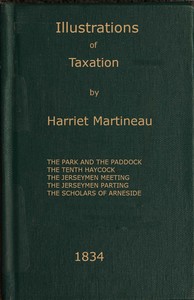
Illustrations of taxation by Harriet Martineau
So, you pick up a book called ‘Illustrations of Taxation’ expecting… well, graphs and dense paragraphs about fiscal policy. What you actually get is something far more compelling. Harriet Martineau, a pioneering writer and social thinker, had a brilliant idea: to explain the complex, abstract world of 1830s British taxation through fiction. She wrote a series of stories, each one a snapshot of a life tangled up in the tax code.
The Story
There isn't one single plot. Instead, the book is a collection of narratives. One story might follow a cider maker watching his profits vanish because of a tax on his product. Another shows a family struggling after a death because of an inheritance tax. A shopkeeper might be driven to smuggling to avoid import duties. In each case, Martineau puts a human face on an economic principle. She shows you the anxiety, the impossible choices, and the quiet desperation that a poorly designed tax can cause. The ‘characters’ are really the taxes themselves—the Window Tax, the Malt Tax, the Poor Laws—and their impact on ordinary people.
Why You Should Read It
This book surprised me. It’s not a historical relic; it feels urgent. Martineau was a master at showing, not telling. You don't just learn that a tax was unfair; you feel its weight on a fictional family's dinner table. It makes you realize how political decisions, especially about money, are never just numbers on a page. They are felt in homes and workshops. Her writing is clear, direct, and often quietly angry on behalf of the common person. Reading it, you get a real sense of the daily tensions in pre-Victorian England, all through the lens of a universal gripe: taxes.
Final Verdict
This is a perfect pick for anyone who loves history but finds traditional textbooks a snooze. It’s also fantastic for readers interested in economics, politics, or social justice, who want to see those ideas play out in human stories. If you enjoyed the narrative approach of books like ‘The Jungle’ by Upton Sinclair but for an earlier era, you’ll appreciate Martineau’s method. Fair warning: it is a book from the 1830s, so the language is formal in places. But the emotions and conflicts are instantly recognizable. It’s a sharp, clever, and deeply human look at where our money goes and why it matters.
This book is widely considered to be in the public domain. You can copy, modify, and distribute it freely.
Andrew Rodriguez
1 year agoClear and concise.




Elijah Rodriguez
1 year agoBeautifully written.