1

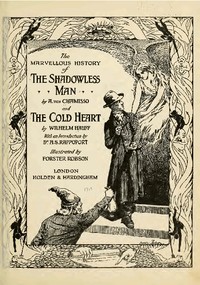
The Marvellous History of the Shadowless Man, and The Cold Heart — Key Ideas to Explore
(0 User reviews)
2283
Project Gutenberg
2010
Not confirmed
Conduct of life -- Fiction; Fairy tales -- Germany; Shades and shadows -- Fiction
Readers of public-domain and historical texts
Project Gutenberg digital edition
en
Edition facts
Words
46,527
Reading time
203 min
Text sections
6
Before opening The Marvellous History of the Shadowless Man, and The Cold Heart — Key Ideas to Explore, the edition data offers a quick orientation: 46,527 words, 3 hr 23 min estimated reading time, and 6 detected text sections.
The text analysis averages about 22.7 words per sentence, while the detected sections provide another way to judge how the source is divided.
Project Gutenberg metadata also associates the work with “Conduct of life -- Fiction,” connecting these edition facts with the source record’s subject description.
Source:
Project Gutenberg record #32219
Two German Romantic tales of supernatural bargains: Chamisso's Peter Schlemihl sells his shadow for a bottomless purse, then traverses the globe in seven-league boots; Hauff's Peter Munk trades his heart for wealth and cold calculation. Both protagonists confront the price of severing themselves from ordinary human connection.
Read the complete public-domain text at its original source.
Read on Project GutenbergThis volume pairs two German Romantic novellas in which a single supernatural transaction reshapes a man's life. In Adelbert von Chamisso's The Marvellous History of the Shadowless Man (1814), Peter Schlemihl trades his shadow to a grey stranger for a purse that never empties—only to discover that a missing shadow makes him an outcast, shunned even by those who covet his gold. The story follows his restless, globe-spanning flight from human society, using seven-league boots to cross continents in a single stride. Wilhelm Hauff's The Cold Heart (1827) offers a complementary fable: the charcoal-burner Peter Munk seeks wealth from the forest spirit Dutch Michael, who replaces his living heart with a stone one, leaving him incapable of joy, fear, or love. Both tales examine what it means to trade an essential part of oneself for material gain, and both protagonists must eventually reckon with the hollow cost of their bargains.
The Shadow as Social Currency
In Chamisso's narrative, the loss of a shadow is not merely a supernatural curiosity but a social catastrophe. When Schlemihl first appears without his shadow at a picnic, the company's reaction is immediate and visceral: the host's daughter Fanny faints, and the entire party recoils. The shadow functions as a visible token of humanity and belonging—its absence marks Schlemihl as fundamentally other. The grey stranger, who later returns to offer the shadow back in exchange for Schlemihl's soul, understands this social calculus perfectly. Schlemihl himself comes to see his condition as a kind of living death: he describes himself as "a captive in his grated cell" even as his boots carry him across the Andes and the polar ice. The narrative repeatedly contrasts the vast, empty freedom of his travels with the cramped isolation of his social exile, suggesting that the shadowless man's true prison is not geographical but relational.
The Stone Heart and Its Consequences
Hauff's The Cold Heart literalizes the emotional deadening that often accompanies the pursuit of wealth. When Peter Munk accepts a stone heart from the forest spirit Dutch Michael, he gains the ability to amass money without pity or sentiment—but he also loses the capacity for simple human pleasures. The text traces this transformation through small, telling details: Peter no longer feels the warmth of the sun, cannot weep at his mother's death, and finds the laughter of his former companions irritating. His wife's fear of his coldness drives her to seek help from the benevolent Glass Manikin, who offers a counter-bargain. The story's structure—two supernatural figures offering competing deals—creates a moral landscape in which the protagonist must choose not between good and evil but between two kinds of magic, one that numbs and one that restores. The stone heart functions as a precise metaphor for the emotional cost of avarice, made physically manifest.
Patterns of Movement and Stasis
Both tales use movement—or its absence—to dramatize their protagonists' inner states. Schlemihl's seven-league boots allow him to cross the globe in moments, yet his narrative is punctuated by repeated returns to a single point: "At last I sat down at the extreme point of Lombock, lamenting." This refrain underscores the paradox of his power: he can go anywhere but cannot escape his own condition. His journeys are frantic, circular, and ultimately fruitless. By contrast, Peter Munk begins as a charcoal-burner rooted in the Black Forest, and his transformation into a cold-hearted capitalist does not take him far geographically—he remains in the same villages and taverns, but his emotional stasis makes him a stranger in his own home. The Glass Manikin's domain is a hidden pine grove, a fixed place of potential redemption. Where Schlemihl's story accelerates into global flight, Hauff's contracts to a local, almost claustrophobic arena, suggesting that the cold heart's prison is not distance but proximity to what one can no longer feel.
Readers approaching these two novellas together will notice how each author uses a fantastic premise to explore a very concrete human anxiety: the fear that one might trade away an intangible but essential part of oneself. Chamisso and Hauff both resist easy moralizing—Schlemihl's fate is ambiguous, and Peter Munk's redemption comes at a cost. Pay attention to the recurring imagery of shadows, hearts, and the natural world, and to the way each story's setting (the open globe versus the enclosed forest) shapes its emotional geography. These are tales that reward rereading, as the details of each bargain reveal new layers of unease.
Reading about Peter Schlemihl’s shadowless wandering, I found myself recalling an old, sunlit afternoon with Tom Swift and His Photo Telephone or the Picture That Saved a Fortune — A Closer Reading. Both tales hinge on invisible severances—one loses a shadow, the other sees through wires—yet each quietly grieves what connection truly costs. The echo lingered, like remembering two distant walks along the same riverbank.
There are no reviews for this eBook.
There are no comments for this eBook.
Reader reflection
Record your reading impressions
A brief reflection can help important ideas stay with you longer.
Your progress
0
/
10
2
Did this book hold your interest?
3
Would you pass this book on to a friend?
4
How easy was the book to follow?
5
Which aspect of the book did you value most?
6
What was its emotional impact?
7
Did the story or argument move comfortably?
8
How useful did the reading feel?
9
What did this book teach you most?
10