1

The Magic Soap Bubble — Background and Themes
(0 User reviews)
88
Project Gutenberg
2008
Not confirmed
Fantasy literature; Fairy tales; Gnomes -- Juvenile fiction
Readers of public-domain and historical texts
Project Gutenberg digital edition
en
Edition facts
Words
20,043
Reading time
88 min
Text sections
3
Before opening The Magic Soap Bubble — Background and Themes, the edition data offers a quick orientation: 20,043 words, 1 hr 28 min estimated reading time, and 3 detected text sections.
The text analysis averages about 19.6 words per sentence, while the detected sections provide another way to judge how the source is divided.
Project Gutenberg metadata also associates the work with “Fantasy literature,” connecting these edition facts with the source record’s subject description.
Source:
Project Gutenberg record #26944
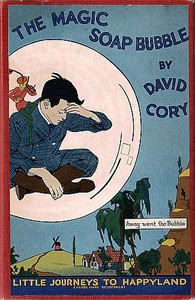
David Cory's 1922 fantasy follows Ned, a boy who meets the King of the Gnomes and travels through Gnomeland via a magic soap bubble, encountering talking animals and magical objects.
Read the complete public-domain text at its original source.
Read on Project GutenbergDavid Cory's The Magic Soap Bubble (1922) opens with Ned, a boy reading a book about fairies and goblins, who is startled by a squeaky-voiced Gnome appearing on his windowsill. The Gnome, claiming to be the King of the Gnomes, invites Ned to journey through Gnomeland. The narrative quickly establishes a pattern: real-world reading gives way to fantastical encounters, and the boundary between book and reality blurs. The King's first words—"Hello, Ned!"—echo the familiarity of a storybook character stepping off the page.
From Book to Bubble: The Framing Device
The opening chapter, "The Magic Soap Pipe," establishes a distinctive framing device. Ned falls asleep reading a book about fairies and goblins, only to be woken by a Gnome who looks exactly like the illustration in his book. This meta-fictional moment—"it almost seemed as if the picture itself had stepped out of the page"—suggests that reading itself is a portal. The Gnome's pipe, which produces a magic soap bubble, becomes the literal vehicle for travel. Cory reinforces this by having the Gnome chide Ned: "Would you read about gnomes and then be so cowardly that you would fear to associate with them?" The story thus positions active imagination as a requirement for adventure.
A Landscape of Contrasts: Forest and Fear
Later excerpts shift from cozy domesticity to a threatening forest. Ned follows a bluebird into a dense wood of "solemn pines and hemlocks," where "great caverns appeared in the rocks and narrow gulleys." The description emphasizes vulnerability: Ned's "knees shaking" and his heart standing still. The forest is populated by a dwarf with "wonderfully brilliant eyes" that "chilled the poor boy's blood." This dwarf, who speaks in a voice "like the cracking of a dry twig," contrasts sharply with the friendly King of the Gnomes. Cory uses sensory details—darkness, strange shadows, ghostly trees—to create a palpable sense of danger, suggesting that Gnomeland is not uniformly benevolent.
Talking Animals and Rhyming Clues
The excerpts include four rhyming quatrains that serve as chapter summaries or songs. One features a bluebird who has lost a magic golden ring, a fish who has it safe inside, and a boy named Jimmy who meets a Rabbitman. Another mentions Shem calling an elephant to leave Noah's Ark for the Circus Folk. These verses hint at a cast of talking animals and interlocking quests. The bluebird, in particular, recurs as a guide and companion, perching on Ned's shoulder and later being placed in his pocket for safety. The rhymes also introduce a playful, musical quality that contrasts with the forest's menace, suggesting that the book alternates between lighthearted episodes and darker trials.
The Dwarf and the Doorway: A Threshold Moment
Near the end of the provided excerpts, Ned encounters a dwarf sitting on a decaying log at the foot of a lightning-struck pine. The dwarf's "ugliest looking" appearance and piercing eyes create a test of courage. When Ned hesitates, the dwarf accuses him of cowardice: "You would read about gnomes and then be so cowardly that you would fear to associate with them?" This direct challenge ties back to the opening theme of reading as a gateway. The dwarf then rises to reveal a doorway in the pine trunk, a classic portal fantasy element. The scene leaves Ned—and the reader—at a threshold, uncertain whether the dwarf is friend or foe, and whether entering will lead to reward or peril.
These excerpts reveal a story that rewards attention to its framing and tonal shifts. The opening's playful book-comes-to-life conceit gives way to a forest that feels genuinely threatening, and the dwarf's ambiguous welcome suggests that not all magical beings are trustworthy. Readers may find it useful to note how Cory uses the bluebird as a barometer of safety—when it perches on Ned's shoulder, the mood is lighter; when it hides in his pocket, danger is near. The rhyming verses scattered throughout also hint at a larger, interconnected world of talking animals and quests.
There’s something tender about a boy rising on a soap bubble into a world of talking animals, the way childhood itself feels weightless. It reminds me of Frank's Campaign; Or, The Farm and the Camp — Context and Discussion, where another young fellow carries that same quiet resourcefulness through harder ground. Both stays with you, like a remembered afternoon.
There are no reviews for this eBook.
There are no comments for this eBook.
Reader reflection
Take a moment to reflect on this book
Create a short personal record of your experience with this book.
Your progress
0
/
10
2
Did this book hold your interest?
3
Would you recommend this book to another reader?
4
What was the reading difficulty like?
5
Did it raise ideas you would like to talk about?
6
Did the book offer a fresh perspective?
7
How would you describe its reading pace?
8
How strongly did the book affect you emotionally?
9
What did this book teach you most?
10