1

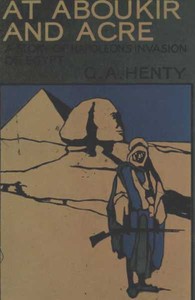
At Aboukir and Acre: A Story of Napoleon's Invasion of Egypt — Background and Themes
(0 User reviews)
521
Project Gutenberg
2007
Not confirmed
Second Coalition, War of the, 1798-1801 -- Campaigns -- Egypt -- Juvenile fiction; Napoleon I, Emperor of the French, 1769-1821 -- Juvenile fiction; Egypt -- History -- French occupation, 1798-1801 -- Juvenile fiction
Readers of public-domain and historical texts
Project Gutenberg digital edition
en
Edition facts
Words
114,804
Reading time
500 min
Text sections
10
Before opening At Aboukir and Acre: A Story of Napoleon's Invasion of Egypt — Background and Themes, the edition data offers a quick orientation: 114,804 words, 8 hr 20 min estimated reading time, and 10 detected text sections.
The text analysis averages about 22.6 words per sentence, while the detected sections provide another way to judge how the source is divided.
Project Gutenberg metadata also associates the work with “Second Coalition, War of the, 1798-1801 -- Campaigns -- Egypt -- Juvenile fiction,” connecting these edition facts with the source record’s subject description.
Source:
Project Gutenberg record #22224
Henty's narrative diction in this Napoleonic-era adventure relies on understatement and physical detail, as seen in a fight scene where a midshipman's injuries are clinically catalogued. Dialogue among officers reveals social hierarchy and stoic humor, while the preface frames the campaign's outcome as inevitable due to British naval power.
Read the complete public-domain text at its original source.
Read on Project GutenbergG. A. Henty opens his account of Napoleon's Egyptian campaign not with a young hero but with a preface that bluntly dismisses Bonaparte's strategic ambitions as a 'wild notion.' The author's voice is that of a confident historian who already knows the outcome: the destruction of the French fleet at Aboukir Bay 'sealed the fate of Napoleon's army.' This certainty shapes the entire narrative, allowing Henty to focus on the texture of military life rather than suspense over the campaign's result.
The excerpts reveal a writer attentive to physical detail and social dynamics. A fight between a master's mate and a new midshipman is rendered through the eyes of officers who discuss it afterward, noting the loser's 'face greatly swelled, eyes closed' and missing teeth. The victor, Blagrove, shows no marks—a detail that underscores Henty's interest in competence and restraint over melodrama.
Understatement and Clinical Detail in Action
Henty describes violence with a precision that borders on medical report. When the master's mate Condor is beaten, the doctor lists his injuries: 'face greatly swelled, eyes closed, very great enlargement of the nose, lips puffed and badly cut, three front teeth missing.' The passage avoids emotional language; the damage is simply catalogued. This restraint extends to the victor, Blagrove, who appears 'as cool as a cucumber' and without a scratch. The first lieutenant's disbelief—'It seems well-nigh impossible!'—is the only overt reaction, and it comes from a character, not the narrator.
This technique recurs in the preface, where Henty calls the French plan 'wild' and 'fantastic' but does not linger on moral judgment. He prefers concrete consequences: 'the extreme danger in which an army landed in Egypt would be placed of being cut off.' The effect is a narrative voice that trusts readers to infer the drama from the facts presented.
Dialogue as a Window into Naval Hierarchy
Conversations among officers reveal a rigid social order and a code of understated humor. The first lieutenant and the doctor discuss the fight with a knowing laugh: 'I should say that it would come under the head of contusions.' The lieutenant's response—'By Jove, that is severe punishment!'—is the closest to surprise. When the second lieutenant scolds a midshipman for 'skulking below,' the boy replies, 'I just slipped below for a few minutes, sir,' and the threat of the mast-head follows immediately.
Henty uses these exchanges to show how rank governs speech. The senior officers speculate about the fight without direct inquiry, and the midshipmen return to deck 'looking as innocent as a cat that has been at the cream-jug.' The dialogue is efficient: it conveys character, tension, and the unwritten rules of shipboard life without explanatory narration.
The Preface as a Strategic Frame
Henty's preface does more than introduce setting; it establishes a thesis. He argues that the campaign was doomed from the start by British naval supremacy: 'the fate of the campaign was indeed decided when the first gun was fired in the Bay of Aboukir.' This judgment colors every subsequent event. The reader knows that Napoleon's army will be 'forced to lay down its arms' and transported back to France in British ships.
The preface also reveals Henty's attitude toward his sources. He mentions Tippoo Sahib and the 'Tiger of Mysore' with a historian's confidence, asserting that the sultan would have turned against the French. This is not a neutral summary but an argument, delivered in the same plain, declarative style as the fight scene. The authorial voice is consistent: direct, opinionated, and grounded in material outcomes rather than romantic ideals.
Physicality and the Absence of Interiority
Henty rarely enters his characters' thoughts. The fight scene is told entirely through external observation: the doctor's report, the lieutenant's guesses, the midshipmen's innocent expressions. When the first lieutenant says, 'I fancy there has been a fight,' he is reconstructing events from visible clues. The narrator never confirms or denies; the reader pieces together the action alongside the officers.
This external focus extends to the hero, Blagrove. He is described as having 'rescued the sheik's son from an attack by two European ruffians,' but the account is secondhand, told at the captain's table. Henty does not dramatize the rescue; he lets the fact stand as evidence of competence. The result is a narrative that values action over introspection, where character is revealed through deeds and dialogue rather than internal monologue.
Readers approaching At Aboukir and Acre will find a story told by a narrator who trusts the weight of concrete detail. Henty's prose rewards attention to what is shown rather than told: the swelling on a face, the tone of a reprimand, the strategic certainty of a preface. The excerpts suggest a work that moves briskly through set pieces, with dialogue and description doing the work of characterization. Those interested in the craft of late-Victorian adventure fiction will find a disciplined example of how to build tension through understatement and external observation.
Reading Henty’s account of the midshipman’s stoic silence after his injuries, I found myself thinking of another kind of mask—the one worn by a man who hides forty faces behind a single calm gaze. There is a quiet kinship in restraint. Cleek: the Man of the Forty Faces — Reading Companion sits on my shelf like a whispered memory of that same composure.
There are no reviews for this eBook.
There are no comments for this eBook.
Reader reflection
What was your reading experience?
Capture what you thought, learned, and would like to remember.
Your progress
0
/
10
2
How did the book work for you overall?
3
Would you recommend this book to another reader?
4
How easy was the book to follow?
5
What was its emotional impact?
6
Did the book offer a fresh perspective?
7
Did the book give you something worth debating?
8
How clear did the writing feel?
9
In one sentence, what did you learn?
10