
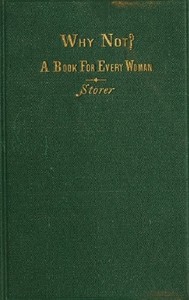
Why not? A book for every woman by Horatio Robinson Storer
Let's set the scene: America in the 1860s. The Civil War has just ended, and a Boston doctor named Horatio Robinson Storer is worried. He's looking at birth rates and seeing a problem—upper- and middle-class white women, in his view, aren't having enough children. His book, Why Not? A Book for Every Woman, is his answer. It's not a novel with a plot, but a persuasive argument, a direct appeal from a physician to his female readers.
The Story
Storer's case is built on a few key points. He believed that limiting family size was selfish, unhealthy, and a threat to the nation's future. He used his medical authority to argue that things like contraception and abortion were physically harmful to women. But he didn't just rely on scare tactics. He also talked about the joys of motherhood and framed having a large family as a noble, Christian, and patriotic act. The "story" here is the unfolding of his campaign, trying to shift public opinion and personal behavior through a mix of science, religion, and social pressure.
Why You Should Read It
This book is a historical punch to the gut, and that's why it's so valuable. It forces you to sit with the uncomfortable reality of how women's lives have been policed. Storer wasn't a cartoon villain; he genuinely thought he was helping. That makes his arguments more insidious and revealing. Reading his words—the blend of concern, condescension, and certainty—you see the blueprint for debates that are still happening. It's a masterclass in how personal choices get tangled up with politics and power. While some parts are frankly hard to read, it gave me a much clearer understanding of the long, tangled history behind the fight for bodily autonomy.
Final Verdict
This isn't a book for a casual beach day. It's for anyone interested in the raw history of medicine, women's rights, or American social movements. It's perfect for history buffs who want to go beyond dates and battles to the ideas that shaped daily life. Book club groups focusing on feminist history would have a field day with it. Approach it not as a guide, but as a primary source—a direct line to a doctor's office in 1867, where the most personal decisions were up for public debate. Keep your historical context glasses on, and be prepared for a fascinating, frustrating, and utterly compelling read.
This content is free to share and distribute. You do not need permission to reproduce this work.
Paul White
1 year agoA bit long but worth it.
Jessica Perez
1 year agoCitation worthy content.









Richard Scott
6 months agoWow.