1

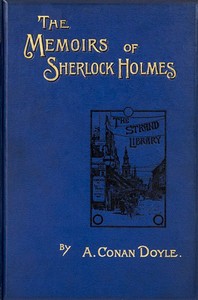
The Memoirs of Sherlock Holmes — Reading Companion
(0 User reviews)
1246
Project Gutenberg
1997
Not confirmed
Holmes, Sherlock (Fictitious character) -- Fiction; Private investigators -- England -- Fiction; Detective and mystery stories, English
Readers of public-domain and historical texts
Project Gutenberg digital edition
en
Edition facts
Words
100,117
Reading time
436 min
Text sections
13
Before opening The Memoirs of Sherlock Holmes — Reading Companion, the edition data offers a quick orientation: 100,117 words, 7 hr 16 min estimated reading time, and 13 detected text sections.
The text analysis averages about 16.4 words per sentence, while the detected sections provide another way to judge how the source is divided.
Project Gutenberg metadata also associates the work with “Holmes, Sherlock (Fictitious character) -- Fiction,” connecting these edition facts with the source record’s subject description.
Source:
Project Gutenberg record #834
In this collection of eleven stories, Sherlock Holmes solves cases ranging from a racehorse's disappearance to a deadly family ritual, with Watson's narration revealing Holmes's methods and the limits of his deductive prowess.
Read the complete public-domain text at its original source.
Read on Project GutenbergThe opening of “Silver Blaze” finds Holmes already immersed in a case before leaving Baker Street, his silent brooding and pipe-charging a familiar prelude to action. Watson’s field-glass is requested, not for observation but as a companionable prop. The journey to Dartmoor is marked by Holmes’s calculation of train speed from telegraph posts—a characteristic display of applied observation. The excerpts show a narrative voice that balances Holmes’s analytical flourishes with Watson’s grounded reporting, a tension that defines the collection.
Evidence and Inference in the Excerpts
The excerpts from “Silver Blaze” and “The Reigate Squires” illustrate how Holmes builds cases from fragmentary clues. In “Silver Blaze,” the torn appointment note is examined with “intense concentration,” and Holmes declares it “of extraordinary interest” before the inspector has finished speaking. The scrap’s hour matches the murder time, yet Holmes resists the obvious theory of servant collusion. In “The Reigate Squires,” the inspector presents a torn paper found in the dead man’s hand, and Holmes again focuses on the writing itself. These moments show that the stories reward attention to physical details—paper, handwriting, timing—over witness testimony. Watson’s role is to record these deductions without fully grasping them, preserving the puzzle for the reader.
Narrative Structure and the Role of Watson
Watson’s first-person narration frames each case as a retrospective account, often beginning with Holmes’s abrupt announcement or a newspaper headline. In “Silver Blaze,” the case is already “the one topic of conversation through the length and breadth of England” before Holmes acts. This technique establishes public context while keeping the solution concealed. Watson’s presence is justified by Holmes’s invitation—“you would confer a great favour”—and his field-glass becomes a token of partnership. The excerpts show Watson as a limited observer: he has not “observed the quarter-mile posts,” whereas Holmes has calculated speed from telegraph poles. This asymmetry creates a reliable but fallible narrator, whose summaries of events are trustworthy but whose interpretations are often corrected by Holmes.
Setting and Atmosphere in the Selected Stories
The settings shift from London to rural estates, each chosen for its isolation and social hierarchy. “Silver Blaze” takes place on Dartmoor, a landscape of moors and stables, where the crime involves a racehorse trainer and a stable boy. “The Reigate Squires” moves to a country house with a locked door and a garden hedge, where the murder occurs at “quarter to twelve.” The excerpts emphasize physical boundaries—hedges, doors, windows—and the difficulty of escape. Holmes’s method relies on reading these spaces: the back passage, the bedroom window, the road. The stories use setting not as decoration but as a constraint that shapes the crime and its detection. Watson’s descriptions are functional, noting distances and positions without embellishment, which suits the logical tone of the collection.
Readers approaching The Memoirs of Sherlock Holmes should attend to the interplay between Watson’s straightforward reporting and Holmes’s oblique reasoning. The excerpts reveal a pattern: Holmes often withholds his conclusions until the final scene, leaving Watson—and the reader—to piece together the clues after the fact. The collection rewards rereading for the details that seem incidental on first encounter.
I finished the Memoirs companion feeling oddly hollow—not from the cases, but from Watson’s quiet acceptance of Holmes’s cold edges. That same weight settled over me later with The Bond of Black — A Reader’s Guide; something about unresolved shadows lingers there too, gentle but unshakeable. It felt less like reading, more like sitting in a dim room after a long talk.
There are no reviews for this eBook.
There are no comments for this eBook.
Reader reflection
How did this book work for you?
Your answers remain private and are stored only in this browser.
Your progress
0
/
10
2
Was reading this book enjoyable?
3
Would you pass this book on to a friend?
4
How much effort did this book require?
5
Was the book what you thought it would be?
6
What did you appreciate most?
7
Did the story or argument move comfortably?
8
How clearly were the main ideas presented?
9
What did this book teach you most?
10